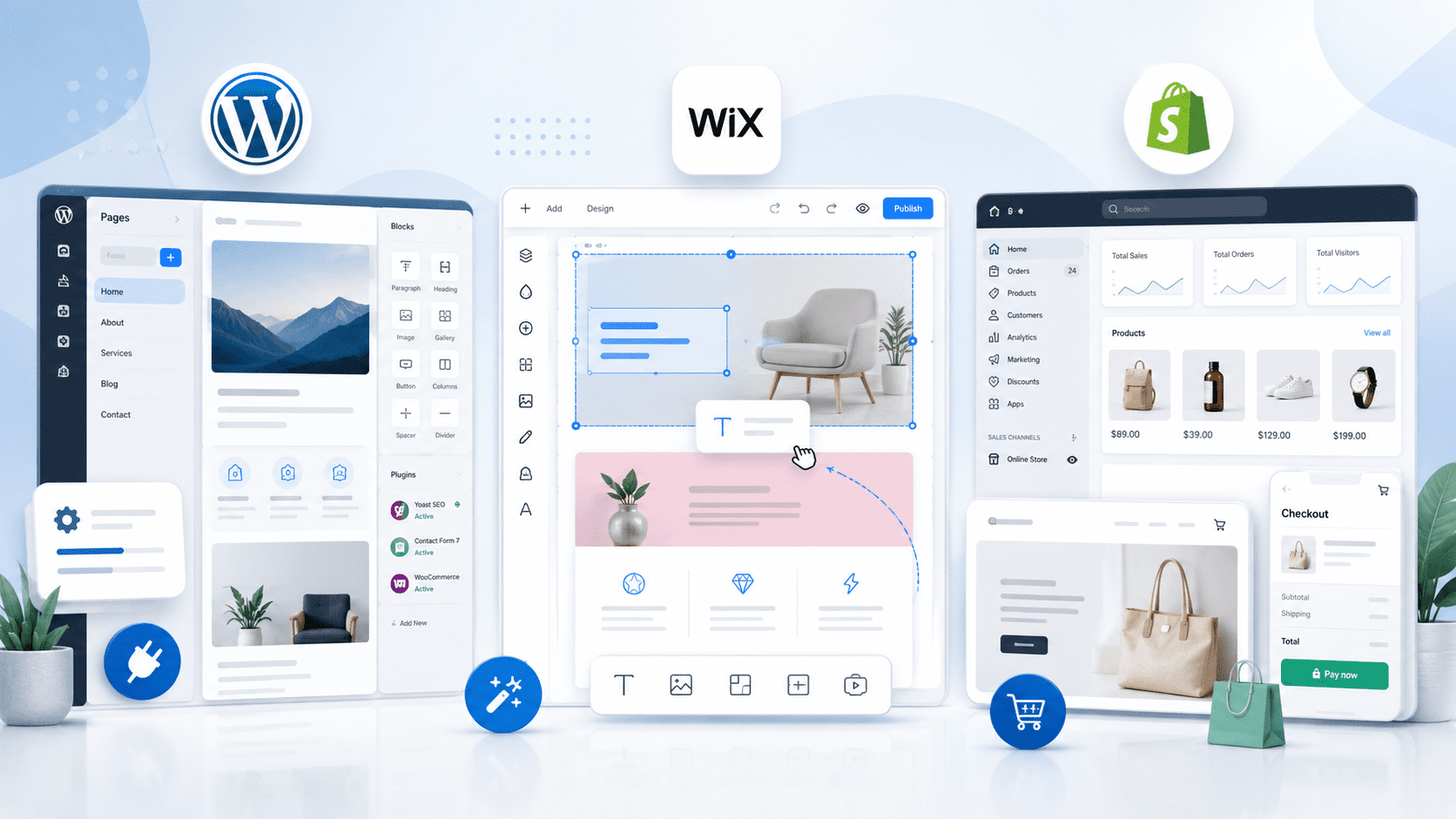
When a company starts planning a new website, one practical question appears quite quickly: which platform should the website be built on? Should you choose WordPress, use a simple website builder like Wix, or build an online store on Shopify?
There is no single right answer for everyone. WordPress, Wix and Shopify can all be good choices, but in very different situations. A bad decision is usually not that a company chooses the “wrong” platform. The real problem is when the platform is chosen only because of price, advertising or convenience, without thinking about what the business actually needs the website to achieve.
One company may need a simple business card website that shows services and contact details. Another company may need an SEO-ready website that grows over time and attracts organic traffic. A third company may need an online store where products, payments, shipping, stock, discount codes and orders work smoothly. A fourth company may need landing pages, advertising, analytics and continuous marketing optimisation.
In this article, we compare WordPress, Wix and Shopify from a business perspective: when each platform makes sense, what limitations to consider, what to keep in mind regarding SEO, maintenance, security, e-commerce, advertising and future growth, and how to make a decision so that the platform does not start limiting the company later.
What does this article cover?
This article helps compare WordPress, Wix and Shopify from the perspective of a business website, online store, SEO, maintenance, marketing, technical control and future growth.
Short answer: when to choose WordPress, Wix or Shopify?
If you want a very short answer, the general logic is this: WordPress works well for business websites, service pages, blogs, SEO and flexible website structures. Wix is suitable when you want to create a small website quickly and manage it yourself with as little technical complexity as possible. Shopify is usually the strongest option when the main goal is selling products and you need a clear e-commerce system.
In real life, however, the choice is not always that simple. You can also build an online store on WordPress. You can build a small online store with Wix. You can also create simple content pages on Shopify. The question is not only what is technically possible. The better question is which platform fits your company’s business model, marketing, budget, skills and future plans best.
If a company sells services, needs strong SEO, content marketing, a blog, landing pages and a flexible website structure, WordPress is often the most logical choice. If the goal is to create a simple website quickly without a developer, Wix may be a practical starting point. If the goal is to build an online store where products, payments and orders are central, Shopify is worth serious consideration.
So a company should not only ask: “Which platform is the best?” A much better question is: what type of website do we actually need, and how should that website help us grow?
WordPress vs Wix vs Shopify: quick comparison
The table below gives a quick overview of situations where each platform usually makes the most sense. It is not an absolute rule, but a practical starting point for business decision-making.
WordPress, Wix and Shopify from a business perspective
Platform choice depends on whether the company needs a simple website, an SEO-focused website, active content marketing or a strong online store system.
| Criteria | WordPress | Wix | Shopify |
|---|---|---|---|
| Best use | Business website, blog, SEO, content pages, service pages | Simple small website that you want to manage yourself quickly | Online store, product sales, orders, payments and growing online revenue |
| Flexibility | Very high when development and maintenance are under control | Good for simple solutions, but more limited for complex needs | Very good for e-commerce logic, but less universal for a traditional business website |
| SEO potential | Strong, especially for content structure and technical SEO | Enough for a simpler website | Good for e-commerce SEO when products, collections and content are built correctly |
| Maintenance | Needs regular WordPress maintenance, updates and backups | Technical maintenance is mostly inside the platform, but flexibility is lower | The technical foundation is managed by the platform, but apps, theme and store logic still need review |
| E-commerce | Possible with WooCommerce, but requires more technical maintenance | Suitable for smaller or simpler online stores | Strongest choice when online sales are the central part of the business |
| Best fit | Service businesses, B2B, blogs, SEO-focused websites | Beginners, micro-businesses, simple business card websites | Online stores, product brands, companies growing online sales |
The most important thing is not to choose the “most popular” platform, but the one that fits your business model, budget, marketing and future plans.
WordPress: a flexible choice for websites, content and SEO
WordPress is one of the most common choices for building a business website. Its main strength is flexibility. With WordPress, you can build a simple business card website, a larger company website, a blog, service pages, landing pages, a multilingual website and even an online store.
WordPress is especially suitable when a company wants to grow its website over time. If the plan is to publish articles, build an SEO structure, create separate service pages, add landing pages, do content marketing or continue developing the website step by step, WordPress gives much more control than many closed website builders.
From an SEO perspective, WordPress is a strong choice because page structure, URLs, metadata, internal links, blog content, images, schema and technical details can be controlled quite thoroughly. This does not mean that WordPress does SEO by itself. It does not. But it gives a strong foundation when the SEO strategy, content and technical side are built correctly.
The weak side of WordPress is that it needs more maintenance. The WordPress core, plugins, theme, contact forms, security settings and backups need regular checks. If a website is left unmaintained for years, security risks, speed problems, broken forms and technical conflicts can appear.
That is why WordPress is best suited for a company that wants a flexible and growing website and is ready to take care of its technical health either internally or with a partner. If you need help, Visibilion can support you with Website development, website maintenance and technical support.
If you need a flexible website that can grow with your company.
Visibilion helps build WordPress websites with a clear structure, SEO-ready foundation, mobile-friendly design and the ability to support advertising, analytics and digital growth.
Wix: a simple solution if you want to start quickly yourself
Wix works well when a company needs a simple website and wants to manage as much as possible itself. The strength of Wix is simplicity: visual builder, ready-made templates, hosting inside the platform and fewer technical decisions. This can be a good choice for a beginner with a small budget whose goal is to get something online quickly.
Wix may be suitable for a small project, personal brand, simple service provider, temporary landing page or a situation where the company does not want to invest in development right away. If the website’s goal is only to show basic services, contact details and a few images, Wix may be a completely sufficient starting point.
The limitations of Wix usually become clearer when the company starts growing. If a more complex structure, deeper SEO control, custom solutions, specific integrations, precise technical optimisation or larger scaling is needed, Wix may become too limited in terms of flexibility.
It is also worth remembering that although Wix reduces the need for technical maintenance, it does not mean the company no longer needs to think about content, SEO, user experience, conversions and marketing. The platform may make building a website easier, but the business result still depends on the offer, structure, texts, visibility and whether the customer reaches the enquiry point.
So Wix is a reasonable choice when the main goal is simplicity and a quick start, not maximum flexibility or a long-term SEO and marketing system.
Shopify: a strong choice for e-commerce and online sales
Shopify is the strongest choice when the company’s main focus is online sales. If you have products that you want to sell online and need a platform where products, payments, orders, shipping, discounts, stock and store management are logically connected, Shopify is worth serious consideration.
The advantage of Shopify is that it is built for e-commerce. With WordPress, an online store is usually built with WooCommerce and different extensions. With Shopify, the store logic is the central part of the platform. This makes starting easier for many companies, especially when the goal is to sell products, not only publish information.
Shopify is a good fit for a product brand, small or growing online store, handmade product seller, clothing brand, food product business, digital product brand or any company that wants to make online sales work faster without building its own technical e-commerce system from scratch.
The limitation of Shopify is that it is not always the best option for a classic service business website or a content-heavy SEO portal. If the company’s main goal is a blog, service pages, a complex content structure and very detailed SEO control, WordPress may be better. But if the goal is sales, products and orders, Shopify is often more practical.
If you want to test an online store yourself, you can start with Shopify here: view Shopify options. If you need help before deciding, Visibilion can help assess whether Shopify, WordPress/WooCommerce or another solution fits your business model better.
If your goal is online sales, Shopify is worth serious consideration.
Shopify works well for businesses where products, payments, orders, shipping and store management are the central part of the website. Before making the final decision, it is still worth evaluating the business model, content, SEO needs and marketing plans.
SEO perspective: which platform helps you grow in Google?
When it comes to SEO, it is not accurate to say that one platform automatically gives good results and another does not. Growth in Google depends much more on content, structure, technical health, user experience, internal links, keywords and consistency. The platform only provides the framework in which SEO is done.
WordPress usually gives the most flexibility for SEO. You can create service pages, articles, categories, internal links, landing pages, custom blocks, metadata and technical solutions. If the company’s growth depends strongly on organic traffic and content marketing, WordPress is often a strong choice.
Wix can be enough for SEO on a simpler website, especially if competition is not very strong and the goal is local visibility for a few main search queries. But if the company wants to build a broader SEO structure, many articles, many service pages and very precise technical control, WordPress may be better.
Shopify’s SEO strength becomes visible in an e-commerce context. Products, collections, categories, product descriptions, images, internal linking and blog content can all support organic growth. However, a Shopify store also needs well-planned SEO. Choosing the platform alone does not bring Google traffic.
If SEO is an important growth channel for your company, the platform decision should be made together with a content strategy and technical SEO plan. Visibilion helps companies evaluate which platform supports their SEO goals better and how to build the website so it does not become weak for future visibility in Google.
Maintenance and security: what should each platform consider?
When choosing a platform, companies often think only about creation: how quickly the website can be ready, how good it looks and how much it costs. But it is equally important to think about what happens after launch. Who maintains the website? Who checks the forms? Who handles updates? Who monitors technical issues? Who knows what to do if something breaks?
WordPress requires the most regular technical maintenance. This means WordPress, plugin and theme updates, backups, security checks, form testing and monitoring the technical condition of the website. This is not a negative thing, but part of WordPress flexibility. However, it must not be forgotten.
Wix and Shopify take care of part of the technical infrastructure themselves. This means that the company has fewer server-level and platform-level decisions to make. But it does not mean that the website does not need any checking. Content, forms, integrations, apps, analytics, SEO, user experience and advertising landing pages still need attention.
If a website or online store is an important sales and marketing channel for the company, it should have a clear maintenance logic regardless of platform. In WordPress, this may mean regular website maintenance. In Shopify, it may mean regular checks of products, apps, theme, checkout, SEO and analytics.
Advertising and analytics: does the platform support marketing?
A business website usually does not exist separately. Traffic comes from Google, social media, advertising, emails, partner links or direct visits. That is why the platform should support analytics, conversion tracking, advertising pixels, landing pages and campaign logic.
WordPress is very flexible in this sense. You can create separate landing pages, add tracking, use forms, measure conversions and adjust page structure according to campaigns. This is useful when a company uses Google Ads, Meta Ads or SEO together with content marketing.
Wix may be enough for simpler campaigns, but for more complex landing pages, tracking and technical optimisation, flexibility may be more limited. Shopify is strong for store analytics and product-related campaigns, but even there, tracking, product pages, collections, advertising channels and email marketing need to work together logically.
If you plan to invest in advertising, the platform should not be chosen only based on where it is easiest to build a nice-looking page. You also need to think about how you will later measure results, test offers, adjust landing pages, improve forms and connect the website with the whole marketing system.
The platform should support not only design, but also marketing.
If the website gets traffic from SEO, Google Ads, Meta Ads or email marketing, the platform must support landing pages, tracking, forms, CTAs and campaign logic.
Costs: monthly fees, development, apps and later work
When comparing platform costs, one common mistake is to look only at the monthly fee or only at the development price. The real cost consists of several parts: platform subscription, domain, hosting, paid apps or plugins, payment solutions, development, design, content, SEO, maintenance, analytics and later changes.
With WordPress, the software itself may be free, but the company still needs a domain, hosting, design, development, plugins, maintenance and technical support. This can mean more work at the beginning, but it also gives more control and flexibility.
With Wix, much of the technical foundation is included in the monthly fee. This makes the beginning simpler, but the company should check which plan is actually needed, whether a custom domain, analytics, e-commerce or other features are included, and what limitations may appear later.
With Shopify, you need to consider the monthly fee, payment costs, possible paid apps, theme customisation, store setup and marketing. At the same time, Shopify can be a very reasonable investment for an online store because much of the sales logic is already built into the platform. If you want to explore the online store options yourself, you can start here: Shopify e-commerce platform.
The cheapest solution is not always the cheapest in the long run. If the platform limits SEO, marketing, development or user experience, later fixing, migration or rebuilding may cost more than making a better decision at the beginning.
How should a business choose the right platform?
When choosing a platform, it is better to start not from technology, but from the goal. What should the website do for the business? Should it bring enquiries? Sell products? Support SEO? Show a portfolio? Enable bookings? Collect email contacts? Work in several languages? Support advertising campaigns?
If the goal is a service-based business website focused on enquiries and SEO, WordPress is probably the right starting point. If the goal is a very simple and quick self-built website, Wix may be enough. If the goal is an online store and product sales, it makes sense to start by comparing Shopify and WooCommerce.
To make a better decision, ask these questions before choosing the platform:
- should the website bring enquiries or sell products;
- how important are SEO and organic growth;
- does the company need a blog or many content pages;
- does the website need to work in several languages;
- does the company plan to use Google Ads or Meta Ads;
- is there a need for an online store, payments, shipping and product stock;
- who will manage the website later;
- what kind of maintenance and technical support the platform needs;
- whether the platform still fits if the company grows.
If these questions are answered before development starts, choosing the platform becomes much easier and later problems become less likely.
Common mistakes when choosing a platform
One common mistake is choosing a platform only because a friend, acquaintance or advertisement recommended it. A platform that works for one business may not work for another. For example, a simple Wix website may be a good starting point for a small project, but not enough for a company that wants to build a large SEO structure. Shopify may be excellent for an online store, but not always the best choice for a service company with a content-heavy website.
Another mistake is thinking only about today’s needs. Today the company may need only one page, but in six months it may need a blog, advertising landing pages, several languages, CRM integration, email marketing or product sales. If the platform does not support growth, the company may quickly face migration or rebuilding.
The third mistake is underestimating maintenance. Every website needs management in some form. WordPress needs more technical maintenance, while Wix and Shopify need less server-side maintenance, but content, SEO, forms, analytics, apps, integrations and user experience still need attention.
The fourth mistake is choosing a platform without a marketing plan. A website does not bring results only because it exists online. The platform should fit how the company plans to grow visibility: SEO, advertising, social media, email, content marketing or partnerships.
Summary: choose a platform based on your business model, not trends
WordPress, Wix and Shopify can all be good choices when used in the right situation. WordPress works well for flexible business websites, SEO and content. Wix is suitable for a simple and quick start when you need a small website and want to manage it yourself. Shopify is a strong choice for online stores where sales, products and orders are the central part of the website.
The most important thing is not to choose a platform only because it seems easy or cheap at the moment. The platform should support how the company actually works and where it wants to go. If a company needs enquiries, SEO and content marketing, one type of solution is needed. If a company needs product sales, payments and orders, a different solution is needed.
A good website is not only a technical choice. It is part of the company’s marketing, sales and trust. That is why platform choice should be thought through before development starts, not after limitations begin to slow down growth.
If you want to test an online store, you can view Shopify options here: start with Shopify. If you are not sure whether WordPress, Wix, Shopify or another solution is better for your company, Visibilion can help think through the platform choice, website structure and digital marketing plan.
Not sure whether to choose WordPress, Wix or Shopify?
Visibilion helps companies choose the right platform for a website or online store, plan the structure, think through SEO, advertising and analytics, and create a web solution that supports business growth.
Write to us and tell us what kind of website or online store you are planning. We help assess which platform fits your company’s goals, budget and marketing plan best.
View website development → Request an initial review →