Website development cost is one of the first questions a company asks before ordering a new website. That is completely logical: before starting a project, a business owner or marketing manager wants to understand whether the website will cost 500 euros, 1,500 euros, 3,000 euros or more. The problem is that the market shows very different prices, and at first glance it may seem that everyone is offering the same thing — “a new website”.
In reality, website creation, website development and full web development are not always the same service. In one case, it may be a simple one-page website or landing page. In another case, the company may need a trustworthy company website with 5–7 main pages. In a third case, the project may require a larger web solution with service pages, categories, product or service cards, a blog, multilingual structure, SEO architecture, analytics and landing pages for advertising campaigns.
That is why the cost of a website mainly depends on what role the website must play. Should it simply introduce the company? Should it generate enquiries from Google? Will it be used for Google Ads or Meta Ads campaigns? Does it need several languages? Does the company also need copywriting, SEO content, images, analytics and conversion tracking?
In this article, we look at how much website development usually costs in Estonia, what shapes the final price, when a simple solution is enough and when it makes sense to choose a more comprehensive web development project.
What will you find in this article?
You can quickly jump to the most important parts of the article and see what website pricing actually depends on.
How much does website development cost in Estonia?
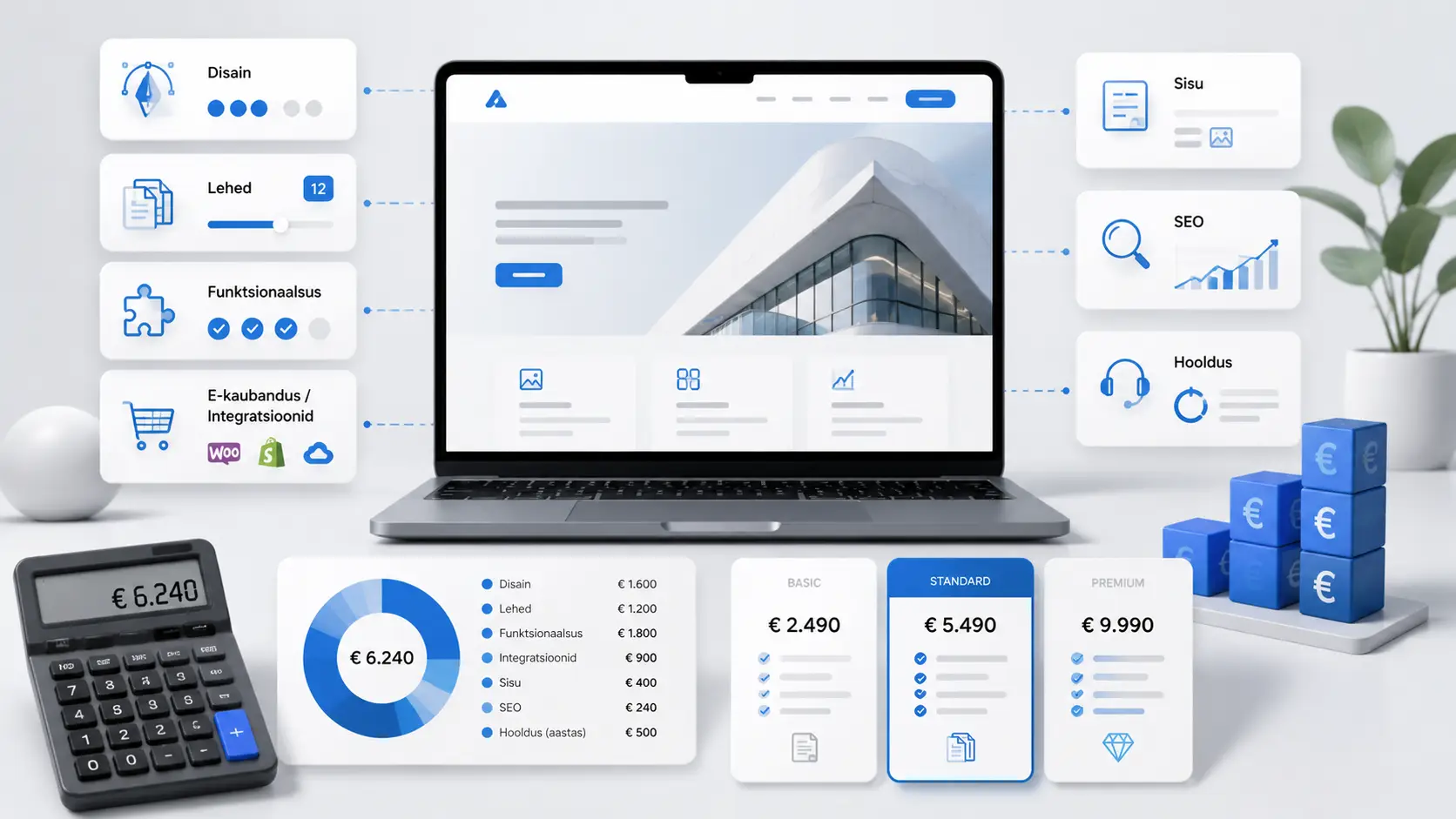
In the Estonian market, website development can start from a few hundred euros and reach several thousand euros. In some cases, the price can exceed 10,000 euros if the project involves a larger custom solution, an online store, complex integrations or a large multilingual web platform. In practical terms, the market can be divided into several pricing levels.
A simple one-page website or landing page may cost around 300–800 euros. This kind of solution works when a company quickly needs a clear page for one service, offer or advertising campaign. It usually includes one main page, a contact form, mobile-friendly design and a simple structure.
A standard company website often falls into the range of about 800–2,000 euros. Such a website usually includes a homepage, services, an “About us” page, a contact page and a few additional pages. In this price range, it already makes sense to think about basic SEO setup, metadata, content structure and analytics.
A more comprehensive company website can cost around 1,600–7,000 euros or more. This includes websites with more services, categories, target groups, languages, a blog, internal linking logic, landing pages, forms, analytics and conversion tracking.
An online store can start at around 1,300–3,500 euros in a simpler form, but a solid WooCommerce store or another e-commerce solution may cost 2,200–8,000 euros and more. The price depends on the number of products, payment solutions, delivery methods, filters, design, integrations and management needs.
It is important to understand that price does not depend only on how many pages the website has. It is just as important whether the website only needs to “exist” or whether it must genuinely help the company grow visibility, trust and enquiries.
Why do website prices differ so much?
If one company offers a website for 490 euros and another for 3,000 euros, it does not automatically mean that one price is right and the other is wrong. The difference is often in what the price includes.
A cheaper website can be a very reasonable choice if the company needs a simple one-page solution, already has texts, images and a clear offer, and the goal of the website is to present basic information. In that case, a large web development project is not always necessary.
A more expensive website is justified when the company has several services, several target audiences, a need for SEO structure, multilingual content, content creation, landing pages for advertising, custom forms, integrations or stronger analytics. In that case, the company is not buying only design, but a complete sales and marketing channel.
The cost of website development can also differ depending on whether the work is done by a freelancer, a small digital partner or a larger agency. A freelancer may be cheaper, but their capacity and range of expertise may be more limited. An agency can offer more people and a larger system, but the price is often higher. A smaller but systematic digital marketing partner can be a good middle ground: flexible enough, but not based only on one person’s capacity.
What affects website cost the most?
The cost of a website is made up of several parts. Some are visible, such as design and the number of pages. Others are less visible, but often much more important: structure, SEO, content, analytics, speed, security and conversion logic.
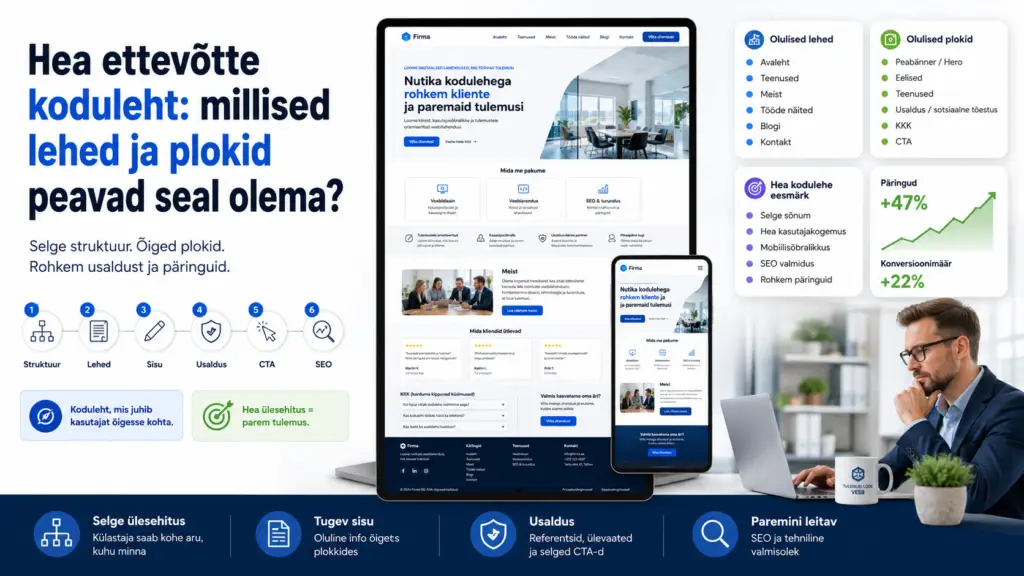
Number of pages and structure
A one-page landing page is cheaper than a company website with 10–20 pages. But it is not only about the number. It also matters whether the pages are logically structured. For example, a service page for “SEO” needs different content than a service page for “Google Ads”. If a company puts all services on one page, the price may be lower, but SEO and user experience may suffer.
Design complexity
A website built on a ready-made design is usually more affordable than a fully custom-designed solution. If the company needs a unique visual identity, complex animations, custom content blocks or very precise UX/UI work, the price increases.
Texts and content
Many companies underestimate texts. If the client provides ready-made copy, the work is simpler. If the website partner needs to help formulate the offer, write service descriptions, create SEO content and structure the messages, the workload becomes larger. At the same time, strong content is one of the most important reasons why a website starts generating enquiries.
SEO setup
SEO does not mean adding a few keywords to a page. A proper basic SEO setup means logical site structure, meta titles, meta descriptions, H1 and H2 headings, image alt texts, internal links, fast loading and a structure that Google can understand. If a company wants to get clients from Google, SEO should not be left as a later add-on.
Languages
A multilingual website costs more because every language version needs translation or adapted copy, separate metadata, menus, URLs and often a separate SEO logic. In the Estonian market, this can be especially important if the company works in Estonian, Russian, English or Finnish.
Technical functions
A contact form, file upload, booking system, payment solution, CRM integration, calculator, filters, product catalogue or e-commerce functionality all affect the price. The more special functions are needed, the greater the development and testing workload.
Analytics and conversions
A good website should show where users come from and what they do on the site. Google Analytics, Google Search Console, Google Ads conversions, Meta Pixel, form tracking and phone click tracking help understand whether the website works. If these are not set up, it is difficult to evaluate later whether the website brings results.
How much would it cost to hire a web developer?
Sometimes a company may wonder whether to order website development from an external partner or hire a web developer in-house. If the company has constant development work, many technical tasks and a daily need for web development, an in-house specialist may make sense. But if the goal is to create a new website, update an existing website or make periodic improvements, using an external partner is often more cost-effective.
Based on public salary data, the gross salary of a web designer or web development specialist in Estonia is often in the range of several thousand euros per month. For example, according to Palgad.ee, the net salary range for a Web Designer position in Estonia is approximately 1,386–3,228 euros per month, for a Frontend Developer position around 1,648–3,409 euros, and for a Software Engineer position around 2,029–4,577 euros per month. The exact salary depends on experience, skills, region and job content.
For the employer, the cost is not limited to the gross salary. In Estonia, employer taxes are added to gross salary, mainly 33% social tax and 0.8% employer unemployment insurance contribution, which means that the employer’s total cost is roughly 33.8% higher than gross salary. For example, with a gross salary of 3,000 euros, the employer’s total cost is around 4,014 euros per month.
In practice, one month of employer cost can already be higher than ordering a simple or standard company website from an external digital partner. In addition, one web developer may not cover all the necessary skills. Website creation often requires structure planning, UX/UI thinking, copywriting, SEO setup, analytics, conversion tracking and project management. If these skills are missing, they must be purchased separately or the quality of the website may suffer.
Time is also important. A simple landing page may take around 20–50 working hours, a standard company website around 50–120 working hours, and a larger website with service pages, content, SEO and analytics 120–250 working hours or more. When a company buys work from an external partner, it pays for a specific result, not a fixed monthly cost.
When is a cheaper website enough?
A cheaper website is not automatically a bad choice. On the contrary, sometimes a simple and fast solution is the most reasonable one.
A cheaper one-page website or landing page works well when the company has one clear service, a specific campaign or needs to be visible online quickly. For example, a new service provider, small business, event, campaign or one-off offer may not immediately need a large website structure.
In that case, it is important that even a simple page is professional. It should have a clear message, understandable offer, trust-building information, a contact form, mobile-friendly design and basic SEO setup. If these parts are present, even a smaller website can be very useful.
The problem appears when a cheap website is only a visual shell: there is no strategy, the texts are generic, SEO is missing, the contact form does not work well and analytics are not measured. Such a page may be cheap, but it may not generate a single enquiry.
When should you choose a more comprehensive web solution?
A more comprehensive web solution makes sense when the website must be an important sales and marketing channel for the company. This means that the website must not only “exist”, but also help grow visibility, trust, traffic and enquiries.
A more comprehensive solution is especially suitable for a company with several services, several target audiences, different product categories, a need for a blog or articles, a multilingual market or a plan to use Google Ads and SEO long term.
For example, a manufacturing company, construction company, consulting firm, B2B service provider or growing local company often needs more than just a homepage and contact form. In that case, the website should have a clear service structure, separate pages for key services, internal linking, CTA blocks, references, portfolio, blog and analytics.
The bigger the business goal, the more important it is that the website is created not only from a design perspective, but also from a marketing and sales perspective.
What should be included in the website price?
When comparing different offers, do not look only at the final sum. Look at what the price includes. Two offers may both say “website development”, but the actual scope of work may be completely different.
A good website development price should include at least the following parts:
- thinking through the goal and structure;
- creating the homepage and necessary subpages;
- mobile-friendly design;
- clear presentation of services or the offer;
- contact form or CTA blocks;
- basic SEO setup;
- meta titles and meta descriptions;
- image optimization;
- Google Analytics or basic analytics setup;
- technical check before publishing;
- guidance or the ability to edit content later.
If the offer is very cheap, it is worth asking whether SEO, texts, analytics, mobile view, forms and technical testing are included in the price or will become additional costs later.
A clear price range before starting the project
At Visibilion, we start website development from a clear price range because a company should understand from the beginning which solution may suit its goal and budget.
Landing page
A compact one-page sales page for a company, service or advertising campaign.
- 1 main page
- Clear structure and message
- Presentation of service or offer
- Contact form or CTA blocks
- Mobile-friendly design
- Basic SEO setup
Growth website
Suitable for a company that needs a trustworthy website for services, content and enquiries.
- 5–7 main pages
- Homepage, services, about and contact
- SEO-ready site structure
- Contact form and CTA blocks
- Mobile-friendly design
- Basic analytics setup
Business website
A larger website for a company with several services, target groups, languages or content directions.
- Wider site structure
- Service pages or categories
- SEO logic and internal linking
- Blog or article base
- Analytics and conversions
- Multilingual structure if needed
Prices are starting levels. The final cost depends on the number of pages, content volume, languages, technical needs, integrations and whether you also need copywriting, SEO content, advertising setup or additional analytics.
How to choose the right solution?
The right solution depends on what the website must do. If you need to quickly test a service or launch an advertising campaign, a landing page may be the best start. If the company needs a trustworthy website for services, content and enquiries, a standard website is suitable. If the company has several services, target groups, languages or content directions, it makes sense to think about a more comprehensive web solution.
A simple rule of thumb:
- if you need one clear page for one offer, choose a landing page;
- if you need a representative company website, choose a standard solution;
- if you want SEO, a blog, several services and room to grow, choose a more comprehensive website;
- if you sell products online, you need an online store;
- if the existing website is old, you may need an update rather than starting completely from scratch.
If it is not clear which option fits, it is sensible to start with a short consultation. Often, the first conversation already shows whether the company needs a small, medium or larger solution.
Should the website price include SEO?
If the website must bring clients from Google, then yes, at least basic SEO setup should be included in the price. Without SEO logic, a new website may look good, but Google may not understand it well for the right searches.
Basic SEO setup does not yet mean long-term SEO service, but it creates the foundation. It includes page structure, headings, metadata, URLs, image alt texts, internal links and technical correctness. If these things are done from the beginning, it is easier to grow organic visibility later.
In Visibilion’s website packages, basic SEO setup is an important part of the work because we do not see a website only as a design project. For us, the website must support visibility, enquiries and measurable marketing results.
Should website content be ordered together with the website?
If a company does not have strong ready-made texts, content should definitely be planned together with the website. Many web projects are delayed because the technical part is ready, but the texts are missing or do not explain the company’s value clearly enough.
Good copy does not only describe what the company does. It helps the client understand why the service is needed, who it is for, what the process looks like and why they should get in touch. Texts also affect SEO because Google needs content to understand which searches the page is connected to.
If the website price includes only design and technical setup, the company may later discover that the website does not work because the message is weak. That is why it makes sense to look at the website as a whole: structure, design, texts, SEO and conversions must work together.
Why you should not compare only the price?
If you compare only the price, the cheaper offer may seem better. But with websites, the real question is: what does the price actually include and what result should the website deliver?
If a 500-euro website does not generate a single enquiry, it may be expensive. If a 1,500-euro website helps the company receive regular new contacts, it can be a very reasonable investment. The value of a website should not be judged only by the cost of creation, but also by how it supports the company’s sales and marketing.
A good website helps to:
- build trust;
- explain services;
- be more visible in Google;
- support advertising campaigns;
- collect enquiries;
- measure marketing results;
- reduce the need for manual explanations in the sales process.
If the website fulfils these tasks, it is not just a cost, but a business tool.
How to get a more accurate quote?
A precise website price can be given when the project goal, number of pages, content volume, languages, technical needs and whether the company also needs SEO, copywriting or advertising-related setup are known.
When sending an enquiry, it is useful to describe:
- what company or service it is;
- whether you need a new website or an update of an existing one;
- how many main pages may be needed;
- whether texts and images already exist;
- which languages the website needs;
- whether you plan to use Google Ads or SEO;
- what the desired deadline is;
- what the approximate budget is.
If you want a more accurate estimate, you can request a website quote through Visibilion’s website development page.
Summary: website cost depends on the goal, not only the number of pages
The cost of website development depends on what kind of website the company needs and what role it must play in the business. A simple landing page may cost a few hundred euros. A standard company website often falls into the range of about 800-2,000 euros. A more comprehensive web solution, online store or multilingual website with SEO structure can cost several thousand euros or more.
The most important thing is not to choose the cheapest or the most expensive solution. It is to choose a website that matches the company’s goal. If you only need a quick representative page, a simpler solution may be enough. But if the website must bring visibility, enquiries and support sales, it makes sense to invest in better structure, content, SEO and analytics.
A good website is not just a collection of files and design. It is a company’s digital sales channel. If it is built properly, it helps the company become more visible, more trustworthy and easier to find for the customers who are already looking for a solution.
Let’s make your website and marketing a clearer growth channel.
Write to us briefly about what your company does and what you want to improve. You do not need a precise brief right away, we will help you understand where it makes the most sense to start.
Tell us about your website, goal and approximate budget — we will suggest which option fits best.
Request a quote →