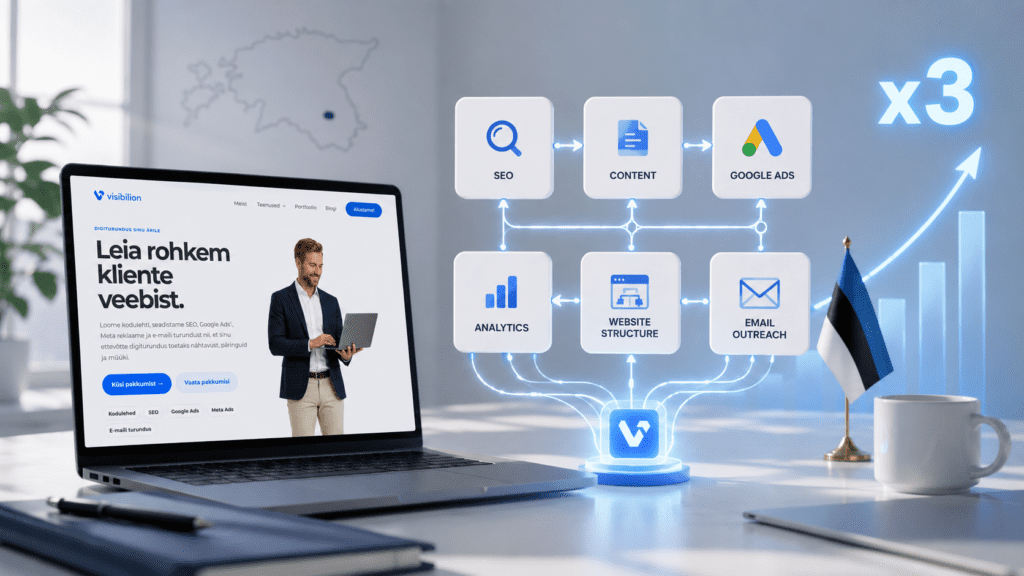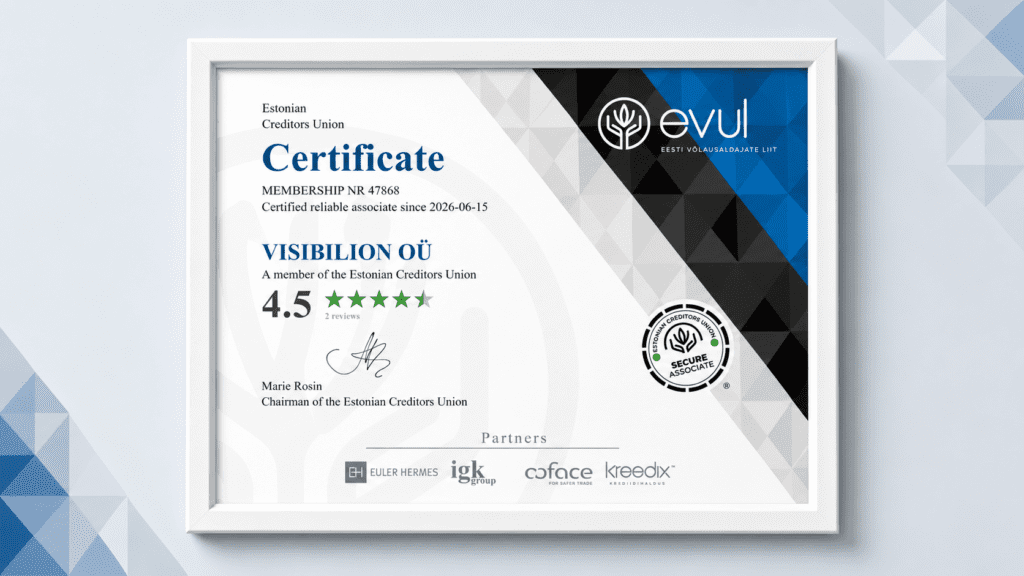

Visibilion turned 7 years old on May 6, 2026, and this birthday felt different to me. Not because the company suddenly became perfect, not because we already had a big team, a fully structured sales department or a dashboard full of impressive numbers, but because I finally admitted something that had probably been obvious for a long time: for most of these 7 years, I was building Visibilion more as a strong specialist than as a real company.
I was doing what many founders of small service businesses do. I took projects, solved client problems, built websites, worked on SEO, wrote content, fixed technical details, launched campaigns, checked analytics, prepared strategies, answered messages, managed deadlines and kept everything moving mostly because I personally knew how to do a lot of things. And to be honest, this worked for quite a long time. It helped the business survive, brought clients, created experience, gave me cases and made me much stronger professionally.
But there is also another side to this kind of growth. At some point, if too much depends on one person, the business starts becoming less of a company and more of a very demanding job with a company name. You can be skilled, fast, useful and even profitable, but still feel that the whole structure is standing on your own energy, your own discipline and your own ability to wake up every morning and push everything forward.
That is why the main conflict of this blog is not “how I started Visibilion”. Visibilion is not a new business. It has existed for more than 7 years. The real question is different: how do I stop being just a strong specialist inside my own business and become the person who actually builds the company? This is what I want to document openly from now on. Not only the beautiful results, not only the successful cases, not only the polished screenshots that look good in a portfolio, but the whole process: decisions, numbers, mistakes, experiments, doubts, corrections, growth and everything that usually stays behind the scenes when companies talk about marketing. I want to show how I am building Visibilion as a system and if our methods really work, the most honest way to prove it is to apply them to our own company first.
The first strategic mistake: trying to look international too early
For a long time, Visibilion lived on the international domain visibilion.com. At that moment, it felt logical to me. A .com domain sounds bigger, more international, more ambitious, and ambition was never the problem. I wanted Visibilion to work with companies from different countries, to look wider than one local market and to be perceived as a digital marketing partner that can think internationally. But looking back now, I think this was one of my first strategic mistakes. Not because international markets are bad, because they are not, and I still want Visibilion to grow outside Estonia in the future. The mistake was in the sequence. I tried to build an international image before building a strong local foundation.
Visibilion is an Estonian company. The company is registered here, the headquarters are here, the first real business environment around the brand is here, and if we want to become a serious digital marketing partner for other companies, it makes sense to prove our methods first in the market where we actually live and work.
There is a difference between being international and just trying to look international. A company does not become stronger only because it has a .com domain, English texts and a wider-looking positioning. A company becomes stronger when it has a clear market, a clear offer, a strong website, visible results, understandable services, good cases, working analytics and a system that can bring leads, conversations and clients.
So this year I made a decision not to renew visibilion.com. Within about a month, the domain was taken by someone from the United States and turned into some cheap-looking website, probably something created for link placement or donor-site purposes. At first, this felt strange, because the domain had been connected with Visibilion for years, but very quickly I started to see it less as a loss and more as a symbol.
The old domain became a reminder of the old mistake: I wanted to build the international version before building the local base properly.
On May 24, 2026, almost right after Visibilion’s 7th birthday, I launched the new local website: visibilion.ee. This time, the logic is different. We are not trying to look bigger than we are. We are building from the real foundation: Estonia first, local visibility first, clear services first, measurable growth first. International expansion can come later, but this time it should be built on top of a working system, not instead of it.
What I did first after launching the new website
The first version of the new Visibilion website was not meant to be perfect, and I think this is important to say out loud, because perfection is one of the easiest ways to delay real growth. If I waited until every page, every language version, every design detail, every article and every visual element was ideal, the website would probably still be somewhere in development, waiting for a perfect moment that never comes.
So I started with the pages that matter most from a business and search demand perspective. First came the main services: website development, SEO, Google Ads, Meta Ads, analytics, digital strategy and related digital marketing services. The goal was simple: if a business owner lands on the website, they should quickly understand what we do, how we can help and why our approach is practical.
I did not want Visibilion to sound like another generic digital agency that says “we help businesses grow online” and then hides everything behind vague words. The website has to explain real services in a normal human way: we build websites, improve SEO, set up and manage advertising, work with analytics, write content, help companies understand what is happening with their traffic and make digital marketing more structured and measurable.
At the same time, I started actively writing articles. Not because “content marketing” sounds nice, but because articles are one of the best ways to build search visibility, explain our thinking and create trust before a person ever speaks to us. I started with topics related to website development, SEO, Google Ads, Meta Ads and digital marketing for companies, because these are the areas where business owners already have questions, doubts and search demand.
The website is still very young, but I already treat it not as a static business card, but as a growing system. Every new page should either bring search visibility, help a potential client understand our thinking, strengthen trust or support future sales conversations. Ideally, one good page should do all of these things at the same time.
The first numbers: May 24 to June 3, 2026
The first period I am looking at is from May 24 to the end of June 3, 2026. This is basically the first visible stage after launching the new website, and I do not want to present it as some huge success story, because it is not. These are early numbers, small numbers, almost baseline numbers. But that is exactly why they are valuable.
If this project grows, these first screenshots will become the starting point. Later I will be able to compare future results with this moment and see what really changed.
According to Google Search Console, during this first period the website received 313 impressions, 1 click, an average CTR of 0.3% and an average position of 66.3. If this were an old, established website, I would not be impressed by these numbers at all. But for a new local website that was launched only a few days ago and is just starting to be indexed, the main thing here is not the click. The main thing is that Google has already started to see the website.
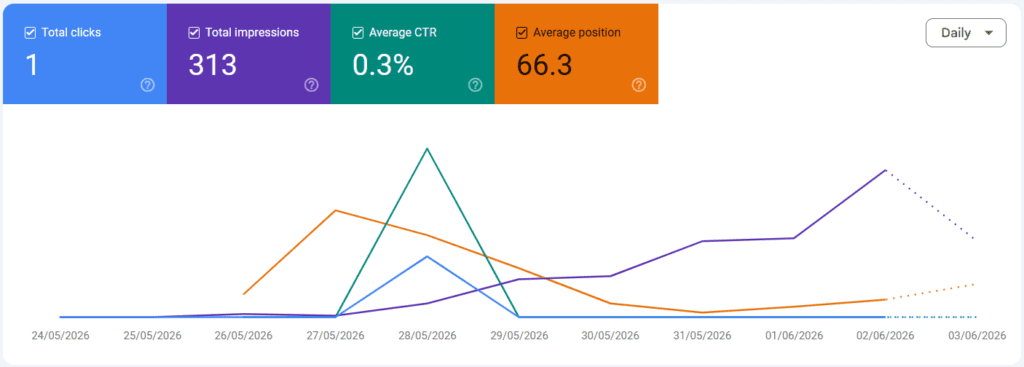
The website is already ranking for 76 keywords in Google, and what matters even more to me is that these keywords are Estonian. This means that the local strategy is starting in the right direction. Right now I do not need random traffic from everywhere. I need relevant visibility in Estonia, because the goal is to build a strong local base first.
Around 96% of the traffic is already coming from Estonia, and for this stage, that is exactly what I wanted to see. Not a large number of visitors from random countries, not international noise, not vanity traffic, but the first small signals from the market that actually matters for this phase.
What Google Analytics and Site Kit already show
In Google Analytics, the website had 89 active users, 128 sessions and 50 engaged sessions during the same period. The engagement rate was 39.06%, and again, while these are still early numbers, they already help me understand how people interact with the new website.

What I like here is that the traffic is not completely empty. People are opening service pages, reading articles, visiting the blog and reaching the contact page. These are small actions, but they show that the website is already doing more than just existing online.
In Google Site Kit, the website shows 97 visitors for the first period. The most visited page is the homepage, followed by the website development page, the blog, the Estdoor case study, the contact page, portfolio and several service pages. The website development page already has 35 pageviews and 37 sessions, the Estdoor case study has 16 pageviews, and the contact page has 11 pageviews and 10 sessions.

For me, this is useful not because the numbers are large, but because the pattern makes sense. People want to understand who we are, what kind of websites we build, what cases we have, what we write about and how to contact us. This already gives me the first clues about what should be improved next: which pages need stronger CTAs, which articles can be connected better with service pages, which topics deserve more content and which landing pages should be used for advertising.
Marketing should not be based only on imagination. Good marketing starts when you look at reality carefully enough and let the data show you where the next step should be.
Small technical steps also matter
One of the first things I did after launching the new domain was very simple and not very glamorous: I changed the footer links on our clients’ websites from visibilion.com to visibilion.ee.
This is not something that sounds exciting in a LinkedIn post, but in practice, these small details matter. If we built or worked on a client’s website and there is a natural credit link in the footer, that link should now point to the domain that actually represents the company. Not to the old international version, not to the domain that is no longer ours, but to the new local Estonian website.
This is not some secret SEO trick. It is just a normal part of cleaning the digital footprint. If the company changes direction, the website, links, profiles, descriptions and all external signals should slowly start reflecting the new direction too.
Storybook became one of the first visibility channels
Another channel I started using almost immediately was ssb.ee. I began publishing shorter versions of our articles there in Estonian and English, with links to the full versions on visibilion.ee.
The logic is simple: if I already write a full article for the website, I can also adapt it into a shorter version and distribute it through a platform where Estonian companies and decision-makers can see it. It gives the content a second life, creates additional visibility, supports referral traffic and helps the company appear more active in the local business environment.
This channel has already brought almost 3,000 views to the company profile and published materials, which is quite interesting for such an early stage. Of course, profile views are not the same thing as clients, and I do not want to pretend that every view is a lead, but attention is still part of the chain.

Many businesses want to jump directly from “we published something” to “we got a client”, but in reality the path is often longer. First people notice you, then they see you again, then they start recognizing the name, then they read something, then they compare, then maybe they visit the website, then maybe they contact you. If the system is built correctly, attention can slowly turn into trust, and trust can turn into conversations.
Paid search: starting small, but with real search intent
I also launched paid advertising, but I did not start with a large budget. The current budget is around $10 per day, and this is intentional. At this stage, I do not need to spend aggressively. I need to understand which keywords, ads and landing pages have potential.
Another important point is that I launched advertising after the website started collecting the first keyword data. I wanted to see at least some early signals from Google Search Console before pushing paid traffic, because then the campaigns can be connected more closely to real demand instead of being based only on assumptions.
Right now, there are 4 search campaigns running. Search campaigns only. This is important because I am not trying to create artificial traffic from broad placements, display networks or random audience expansion. I want to test people who are already searching for website development, SEO, Google Ads and digital marketing services in Estonia.
So far, Google Ads has brought 12 clicks, 223 impressions, an average CPC of $1.46 and $17.57 in spend.

These numbers are too early for any serious conclusion, and I would never tell a client that we can judge a campaign properly after such a small amount of data. But the learning process has already started. Now I can see which keywords trigger impressions, which ads get clicks, where the CPC is acceptable, which landing pages people visit and what should be rewritten, excluded, separated or tested again.
For me, this is how marketing should be built: not emotionally, not randomly, not with one big beautiful launch and then silence, but step by step, with data, corrections and patience.
Email outreach: not glamorous, but necessary
At the same time, I started manually collecting a database of Estonian companies from different niches, mostly from areas where we already have experience or at least understand the business logic. Manual work takes more time, of course, but at this stage I prefer better quality over random volume.
I set up automated email outreach through Instantly, including follow-up sequences, because in B2B one email is usually not enough. People are busy, they miss messages, they postpone decisions, they need reminders, and if the offer is relevant, a good follow-up can make the difference between silence and a conversation.
Of course, proper email outreach is not just uploading contacts and sending messages. You need to warm up mailboxes, prepare domains, think about deliverability, avoid spam signals, write normal human emails, test sequences and not behave like a desperate company that is shouting at everyone. So the first few days went into setup, warming and preparation.

I also bought the domain visibilion.eu to increase future sending capacity and protect deliverability, because if email becomes one of the acquisition channels, it has to be treated as a system, not as a one-time experiment.
Now the first campaigns are slowly starting, and this is another part of the mechanism: website, SEO, content, paid search, business platforms, email outreach, LinkedIn and later cold calls. None of these channels alone is magic. But together, if they are connected properly, they can create a much stronger growth system.
Why I created Visibilion Eesti on LinkedIn
Another decision was to move away from the overly international feeling for now and create the company page as Visibilion Eesti. This is a small naming decision, but strategically it matters, because the goal right now is not to look global, but to become more visible and trusted in Estonia.
LinkedIn will be one of the channels for building visibility, both through the company page and through my personal profile. On the company side, the focus will be more local and service-based. On my personal profile, I want to write in English about how I am building Visibilion, what we are testing, what works, what does not work and what I learn as a founder.
This difference is important. The website and company content can speak more directly to the Estonian market, while my personal LinkedIn can tell the broader story in English: how an Estonian digital marketing company is being rebuilt from the inside, from a founder-led specialist business into a more structured growth company.
In the future, I still want international expansion. I have not abandoned that idea. But this time, international growth should come from a stronger base, not from the desire to look bigger too early.
The next step: speaking with decision-makers
The next step is cold outreach through calls, especially to decision-makers from companies that have already received emails. This is not the most comfortable part for many digital people, but I think it is necessary.
A website can tell you a lot. Analytics can tell you a lot. Search data can tell you a lot. But actual conversations with business owners and managers tell you things that dashboards cannot. They reveal real objections, real priorities, real budgets, real doubts and the actual language people use when they talk about their problems.
I do not want Visibilion to be built only inside Google Analytics. I want it to be built in the market, through content, search, ads, email, LinkedIn and conversations with real people.
Especially in B2B, you cannot hide behind dashboards forever. At some point, you need to talk to people and understand whether your offer is clear, whether the pain is real and whether the market actually reacts to what you are building.
What I want this blog to become
I do not want this blog to be a collection of polished success stories written after everything already looks good. There are enough of those. Most companies show the result when it is already clean, packaged and safe. But very few show the messy middle, where decisions are made, mistakes become visible, numbers are still small and the system is still being built.
For me, that part is much more interesting.
I want to show how I rebuild Visibilion from the inside. How I make decisions, what I test, what I change, where I was wrong, which numbers matter and which numbers are just noise. I want to show the work not only as a marketer, but as a founder who is learning to build a company instead of personally carrying everything on his own skills.
This is also why I think this story can be useful for other business owners. Many small companies are built around one strong person. The owner sells, manages, solves, controls, improves, answers and pushes everything forward. It works for some time, but eventually the same question appears: how do you turn personal skill into a company system?
This is exactly the question I am asking myself now and I want to answer it publicly.
Why this matters for our clients too
This story is personal, but it is also directly connected to how we work with clients. I do not believe that digital marketing should be a collection of disconnected services. A website here, some SEO there, a few ads somewhere, a report nobody reads and a landing page nobody improves — that is not a growth system. That is decoration.
Real growth usually appears when everything is connected: the offer, the website, search demand, content, paid traffic, analytics, email outreach, follow-ups, sales conversations and regular improvements. When one part of the system gives data to another part. When content supports SEO. When SEO supports trust. When ads test demand. When analytics shows weak points. When outreach starts conversations. When conversations improve the offer.
This is what I want to build for Visibilion, and this is what we help build for other companies. Not marketing noise or random activity, not “let’s post something and hope”, but a working mechanism.
The baseline of the new Visibilion
So this is the baseline of the new Visibilion website from May 24 to June 3, 2026.
The new local website is live. The site is already ranking for 76 Estonian keywords. Around 96% of the traffic comes from Estonia. Google Search Console shows 313 impressions, 1 organic click, 0.3% CTR and an average position of 66.3. Google Ads has generated 12 clicks from 223 impressions with an average CPC of $1.46 and $17.57 spent. Google Analytics shows 89 active users, 128 sessions and 50 engaged sessions. Site Kit shows 97 visitors, with the homepage, website development page, blog, Estdoor case study and contact page among the most visited pages. SSB.ee has already brought almost 3,000 views to the company profile and article materials. Email outreach has started. Follow-up sequences are prepared. LinkedIn is being connected to the local strategy. Cold calls are next.
These are not big numbers yet, and I do not want to pretend they are. But they are the first signals of a system that has started moving.
And honestly, I like this moment exactly because it is still small. There is no big victory to decorate, no illusion to sell, no dramatic success story to exaggerate. There is only the beginning of a more serious approach.
Visibilion is not starting from zero as a business, but visibilion.ee is starting almost from zero as a new local growth platform. And from now on, I want to show how it grows, what I do, what works, what fails and what I learn on the way.
For years, I built Visibilion mostly with my own hands.
Now I want to build it as a system.
Let’s see what happens next.