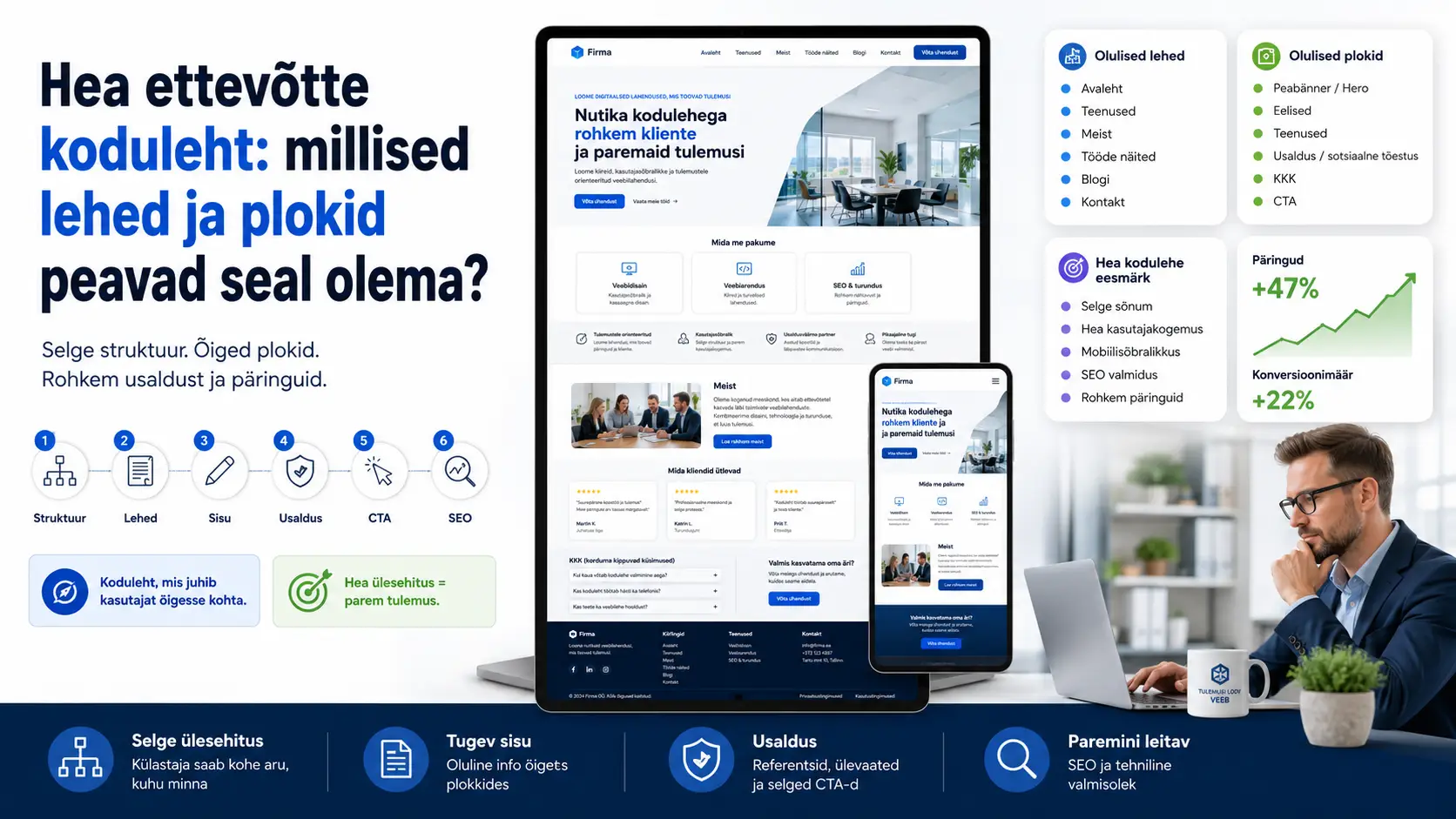
A company website is not just a place to put a logo, contact details and a short description of services. A well-structured website helps a potential client quickly understand what the company does, who its services or products are for, why the company can be trusted and how to take the next step. When a website is clear, logical and useful for the user, it supports sales, marketing, SEO and the company’s credibility.
Many companies start website development from design, but the first question should actually be different: what information does the client need before they contact the company or make a buying decision? This determines which pages, blocks and content elements the website should include. A good website does not always have to be very large, but it must be well thought through. Every page and every block should have a purpose.
Below, we look at which pages and blocks a good company website should include and why they are important both for user experience and search engines.
Homepage: a clear first impression and quick understanding of the offer
The homepage is often the first place a potential client lands on. Its task is not to say everything at once, but to quickly explain who the company is, what it offers and why the user should continue. If the visitor does not understand within the first few seconds what the company does, they may leave before reaching the services or contact section.
A good homepage should be built as a logical journey. The first screen should contain a strong headline, a short explanation and a clear call to action. After that, the page can show the main services or products, the company’s strengths, trust-building elements, completed work, client feedback and finally a contact option. The homepage should guide the user to more specific pages, not try to replace the entire website structure.
For example, if a company offers digital marketing services, the phrase “we help companies grow” is not enough on its own. The user wants to understand whether the company builds websites, does SEO, Google Ads, Meta Ads, email marketing or strategy. When these services are shown briefly and clearly on the homepage, the user can choose the right direction and move to a specific service page.
A homepage may include the following blocks:
- a strong hero block or first screen;
- a short company value proposition;
- an overview of main services or products;
- why choose this company;
- examples of completed work or clients;
- client feedback or trust-building elements;
- a short process description;
- repeated CTAs encouraging contact;
- a contact block or link to the contact page.
The homepage does not have to be too long, but it must answer the user’s main questions and help them quickly reach the right page.
Services or products overview page: clear navigation for the user
If the company has several services or products, it makes sense to create a separate overview page. It helps the user quickly see what the company offers and choose the relevant service. At the same time, such a page also supports SEO because it creates a logical central place from which links lead to more detailed service or product pages.
A services page should not be just a long list. Each service should be briefly explained so that the user understands who it is for and what problem it solves. If service names are too technical or generic, the client may become confused. That is why it is useful to add a short description, benefit and clear link to a more detailed page for each service.
For example, the service “SEO” may be clear to a specialist, but for a business owner a more useful explanation is: “We help your company website become more visible in Google and generate more organic enquiries.” This wording immediately connects the service to a business outcome.
A good services overview page may include:
- a short introduction to the company’s solutions;
- service or product cards;
- a short description of each service;
- clear links to detailed pages;
- a recommendation on where to start if the client is not sure what they need;
- a contact block or consultation invitation.
This type of page works well for both users and search engines because it brings clarity to the website structure and helps connect related services.
Separate service pages: every important service needs its own page
One common mistake on company websites is placing all services on one general page. This may seem simple, but from a user and SEO perspective it is not always the best solution. If the company has several important services, each main service should have its own dedicated page.
A separate service page allows the company to explain a specific service in more depth. The user can learn what the service includes, who it is for, what problem it solves, what the process looks like and why the company is a trustworthy provider. A service page can also be optimized for a specific keyword, such as “website development”, “SEO service”, “Google Ads management” or “email marketing”.
A good service page should not be only sales copy. It should be genuinely useful. A potential client may still be at the beginning of their decision-making process and comparing different options. If the page answers their questions better than a competitor’s page, the chance of an enquiry increases.
A service page may include the following blocks:
- a clear H1 heading;
- a short introduction to the value of the service;
- who the service is suitable for;
- which problems it solves;
- what is included in the service;
- a description of the work process;
- results or expected benefits;
- examples, portfolio or case studies;
- frequently asked questions;
- a contact form or CTA.
If a service is commercially important for the company, it is worth creating a detailed and well-structured page for it. In the long run, this works better than a short general description.
We help build websites that support enquiries.
We review pages, blocks, CTAs, service structure and the user journey.
About page: building trust and showing the company’s face
The “About us” page is often underestimated, but it can play an important role in building trust. When a potential client is considering getting in touch, they want to know who is behind the company, what experience it has and whether it is a reliable partner. Especially in service businesses, the “About us” page can influence the decision to send an enquiry.
A good “About us” page should not be only a dry company history. Of course, it can mention the founding, experience and field of work, but it is even more important to explain the company’s thinking, working principles and value for the client. The user does not only want to read when the company was founded. They want to understand why it can be trusted.
If possible, it is worth adding real photos, team introductions, experience, important projects or areas where the company is strong. An anonymous website creates less trust than a website where people, competence and a clear story are visible.
A good “About us” page may include:
- a short company introduction;
- the company’s mission or working principles;
- experience and strengths;
- introduction of the team or key people;
- photos;
- examples of clients or projects;
- an explanation of who the company creates the most value for;
- a link to the contact page or a consultation invitation.
Trust is especially important when the service is expensive, complex or long-term. The “About us” page helps make the company more human and convincing.
Portfolio, references or completed work
If the company can show previous work, a portfolio or references page should definitely be present. It helps a potential client see that the company has real experience and the ability to deliver what it promises. Many people trust specific examples more than general claims.
A portfolio is not useful only for design or web development companies. A manufacturing company, construction business, service provider, consulting firm or marketing agency can also show completed projects, client stories, results or processes. The important thing is to choose a format that helps the client understand the company’s value.
A simple image gallery is better than nothing, but a short project description is stronger. For example: what was the client’s problem, what solution was created, what the process looked like and what result was achieved. If numbers cannot be published, the scope of work, industry and logic of the solution can still be described.
A portfolio or references page may include:
- an overview of projects;
- a short description of each project;
- the client’s industry;
- a description of the work or solution;
- results, if they can be published;
- visuals, photos or screenshots;
- client feedback;
- a CTA for discussing a similar project.
A good portfolio is not only “look what we did”, but “look what kinds of problems we can solve”.
Blog or knowledge base: long-term support for SEO and trust
A blog is not mandatory for every company in the same volume, but a content-based knowledge base can be very valuable. It helps answer client questions, bring organic traffic from Google and demonstrate the company’s expertise. Especially in B2B, services and higher-value buying decisions, good content can give the client more confidence before getting in touch.
A blog should not be a collection of random news. It is better to think about the questions clients actually ask. What do they not understand before buying? What mistakes do they make? Which services do they compare? Which searches do they use in Google? Articles that answer these questions can bring quality traffic and support sales.
For example, a digital marketing company can write articles about Google Ads problems, SEO principles, website structure or B2B marketing. These topics are not just “blog posts” — they help educate a potential client and guide them toward the right services.
A good blog or knowledge base may include:
- practical guides;
- answers to recurring questions;
- comparisons and explanations;
- industry advice;
- internal links to related services;
- a clear category structure;
- CTAs at the end of or inside articles;
- regularly updated content.
A blog works best when it is connected to the company’s services and sales process. Every article should support a topic, service or client decision stage.
Contact page: simple, clear and trustworthy way to get in touch
The contact page is one of the most important pages on the entire website. If a person is ready to get in touch, nothing should stand in their way. Contact details must be clear, the form must work and the user must understand what happens after submitting an enquiry.
Too often, the contact page is very minimal: email address, phone number and a form. This may be enough, but a better contact page gives the user more confidence. For example, it can include a short text about what questions the company can help with, how quickly it usually responds and what information should be included in the enquiry.
If the company has a physical location, it is worth adding an address, map and opening hours. For service-based or B2B companies, a direct invitation can also be useful: “Let’s talk about your project” or “Send us a short description and we will get back to you”. This makes getting in touch less formal and easier.
A contact page may include:
- a contact form;
- email address;
- phone number;
- company address, if relevant;
- company registration details;
- a short guide for sending an enquiry;
- information about response time;
- alternative contact options;
- a link to the privacy policy if the form collects personal data.
The purpose of the contact page is to remove the final obstacle. If a person reaches it, they should be able to take the next step quickly and comfortably.
Frequently asked questions, or FAQ
An FAQ block may seem like a small detail, but it is very useful both for the user and for SEO. Frequently asked questions help answer doubts that may appear before submitting an enquiry. If the user finds the answer directly on the page, it becomes easier to decide.
FAQ is especially useful on service pages, where the user may have many practical questions: price, process, timeline, cooperation format, guarantee, maintenance, preparation or measurement of results. FAQ also reduces repeated questions for the sales team because part of the information is already available on the website.
It is important that FAQ is not filled with artificial questions. The questions should come from real client communication, sales calls, emails and search queries. Answers should be specific enough, not just one sentence.
Examples of good FAQ questions:
- How long does website development take?
- What does the service price depend on?
- Can I edit the website myself later?
- Is SEO included in website development?
- How quickly do Google Ads results appear?
- Do we need ready-made texts and images before starting?
- What does the cooperation process look like?
FAQ makes the website more useful and reduces uncertainty. It is a small block whose impact may be bigger than it seems at first.
CTA blocks: the user must be guided to the next step
CTA, or call to action, is a prompt for the user to act. It can be a button, form, link or text block that guides the user to the next step. Without clear CTAs, a person may read the page but not take any action. A good website does not leave the user wondering what to do next.
The CTA must be connected to the page content. On a service page, “Request a quote”, “Let’s discuss your project” or “Book a consultation” may work well. In a blog article, a softer prompt may fit better, such as “Need help with your website?” or “Want to understand how your website could work better?”. On the homepage, the CTA may guide the user to services or contact.
It is important to repeat CTAs. If the page is long, one button at the beginning is not enough. The user may decide only after reading several sections, so a contact option should also be visible in the middle and at the end of the page. At the same time, the CTA should not be too aggressive or interrupt reading.
A good CTA is:
- clear;
- specific;
- visible;
- connected to the user’s need;
- low enough in risk;
- repeated, but not pushy.
For example, “Contact us” is neutral, but “Let’s discuss your website goals” can be much more specific and user-friendly when the page is about website development.
Trust-building elements: proof is stronger than promises
Companies often write that they are professional, high-quality and trustworthy. These claims may be true, but concrete proof is much more convincing for the user. Trust-building elements help show that the company has experience, clients and real ability.
Such elements can include client logos, feedback, certificates, project examples, team photos, results, awards or partnerships. It is important to choose the proof that actually matters to the target audience. For a B2B client, industry experience and processes may be important. For a private client, reviews and photos of completed work may matter more.
Trust can also be built through transparency. When the page clearly explains the work process, pricing principles, response time and cooperation stages, the client feels more confident. Not everything has to be published as a detailed price list, but the user should understand what to expect.
Trust-building elements may include:
- client feedback;
- client or partner logos;
- examples of completed work;
- certificates;
- team introduction;
- real photos;
- results and numbers;
- process description;
- guarantee or quality principles.
A good website does not only say “trust us”. It shows why the company can be trusted.
Pricing information or pricing principles
Not all companies want to show their prices publicly on the website. This is understandable, especially when services are individual or project-based. At the same time, users often want to understand the approximate budget level before sending an enquiry. If pricing information is completely missing, some potential clients may leave.
Pricing information does not always have to be an exact price list. It can explain what the price depends on, which factors influence project cost and what the minimum starting level is. For example, in web development, price may depend on the number of pages, design complexity, content, languages, functionality and SEO needs. This kind of explanation helps the client understand why project prices differ.
A pricing block can also reduce unsuitable enquiries. If the company works only from a certain budget level, communicating this saves time for both sides. At the same time, it should be done tactfully so that it does not push potential clients away.
A pricing block can explain:
- what the price depends on;
- what typical packages or project levels are;
- whether the company offers fixed prices or hourly work;
- whether the initial consultation is free;
- what the client should provide to receive an offer;
- why the cheapest solution is not always the best.
Clarity in pricing does not always mean a complete price list. It means the client understands how prices are formed and what information is needed for an offer.
Process description: the client wants to know what happens next
When a person considers ordering a service, they want to know what cooperation looks like. This is especially important when the service is new, complex or connected to a larger investment. A process description reduces uncertainty and shows that the company has a clear system for the work.
For example, in website development, the process may include an initial consultation, needs mapping, structure creation, design, development, content adding, testing and publishing. When the client sees these steps, they better understand what is expected from them and how long the project may take.
The process description does not have to be too technical. A simple and understandable overview is enough. The important thing is to show that the company does not work randomly, but follows a clear plan. This builds trust and helps the client decide.
A process block can answer:
- how the cooperation starts;
- what the main stages are;
- what the client needs to prepare;
- how long the process usually takes;
- when the client can give feedback;
- what happens after the work is completed.
A good process description makes buying the service easier. The client does not have to guess what happens next — they can already see it on the website.
Internal links between blog articles and service pages
A good company website is not made of separate standalone pages, but of a logically connected system. Internal links help the user move from one topic to another and also give Google a better understanding of the website structure. If internal links are not used, some valuable content remains hidden from the user.
For example, a blog article about website development could link to the “Website development” service page. The service page could then link to case studies, related blog articles or the contact page. This logical connection helps the user get more information and move toward an enquiry.
With internal links, it is important to use natural anchor text. “Read more here” is better than nothing, but it is even better to link with descriptive text, such as “company website development” or “SEO service”. This helps both the user and search engines.
A good internal linking system:
- connects service pages with related articles;
- guides users from the blog to services;
- helps the user find the next logical step;
- strengthens SEO structure;
- reduces exits from the page;
- makes the website more complete.
There do not need to be too many internal links, but they should be thoughtful and useful.
What is the minimum structure of a good company website?
Not every company needs a large website immediately. A smaller business can start with a simpler structure and add new pages later. The important thing is that the website is logical, expandable and understandable for the user from the beginning.
The minimum structure could be:
- Homepage;
- Services or products;
- Separate main service pages;
- About us;
- Portfolio or references;
- Blog or knowledge base;
- Contact.
If the company has only one main service, the structure can be smaller. If there are several services and SEO matters, it is worth creating more separate pages. If the company sells internationally, languages, markets and industry-specific landing pages should also be considered.
The goal of a good website is not simply to create as many pages as possible. The goal is to create a structure that helps the client find information, helps the company be visible and helps generate enquiries.
Summary: a good website is a well-thought-out system
A good company website is not made of random texts and beautiful blocks. It is a well-thought-out system where every page and every element has a role. The homepage creates the first impression, service pages explain the offer, the “About us” page builds trust, the portfolio shows experience, the blog supports SEO and the contact page helps the user take the next step.
The most important thing is to think about the user journey. What information does the user need on the first visit? What questions do they have before sending an enquiry? What could prevent them from getting in touch? If the website answers these questions, it works much better than a website built only from the company’s own point of view.
A good website does not have to be perfect all at once, but it must be clear, useful and expandable. When structure, content, CTAs, trust-building elements and SEO are thought through from the beginning, the website becomes a strong sales and marketing channel for the company.
Let’s build a website that is clear, trustworthy and supports sales.
Write to us if you want a website where structure, content and CTAs help generate more enquiries.
Tell us briefly about your company and website goal. We will suggest what structure and blocks make sense.
Request an initial review →