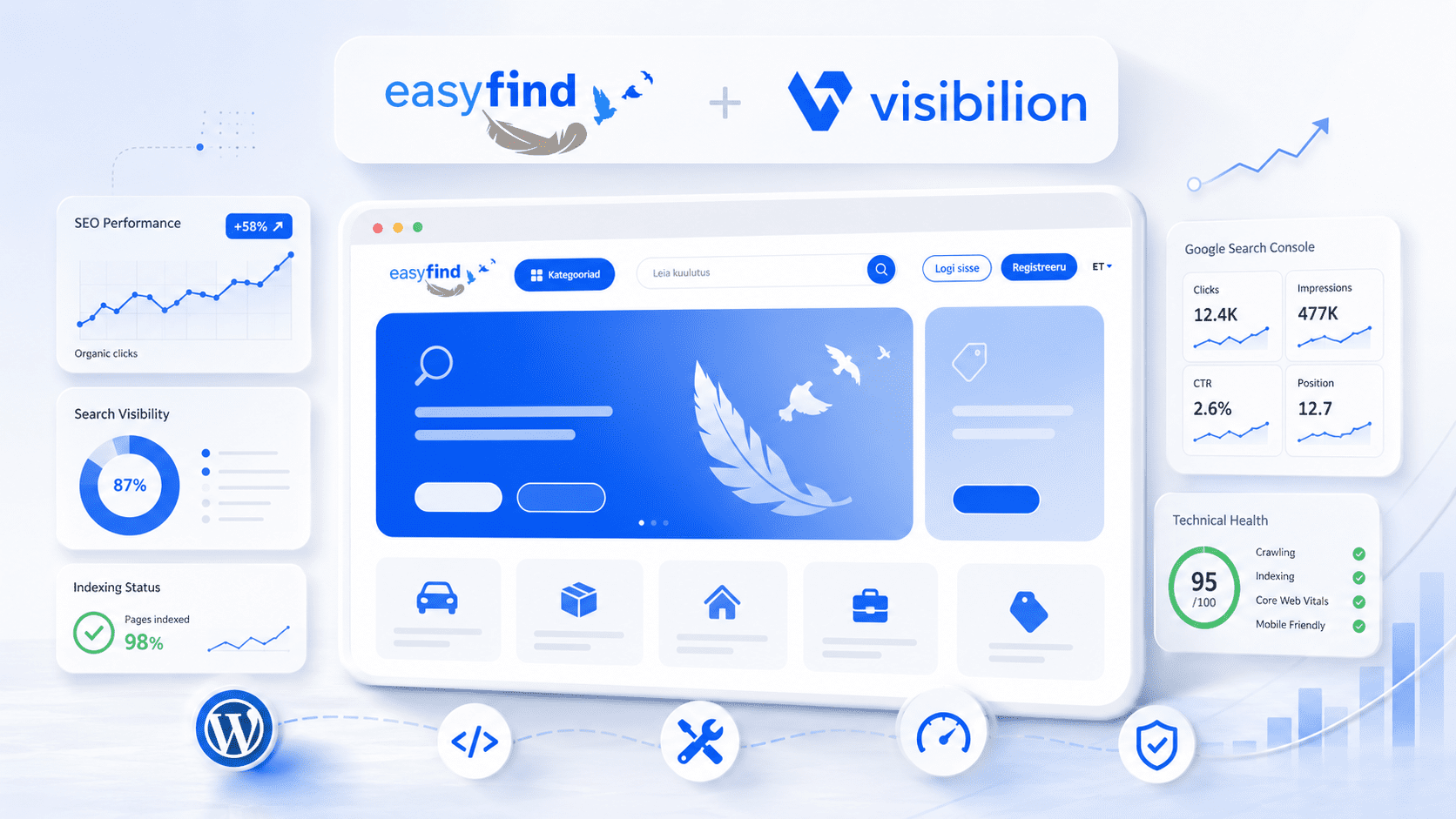
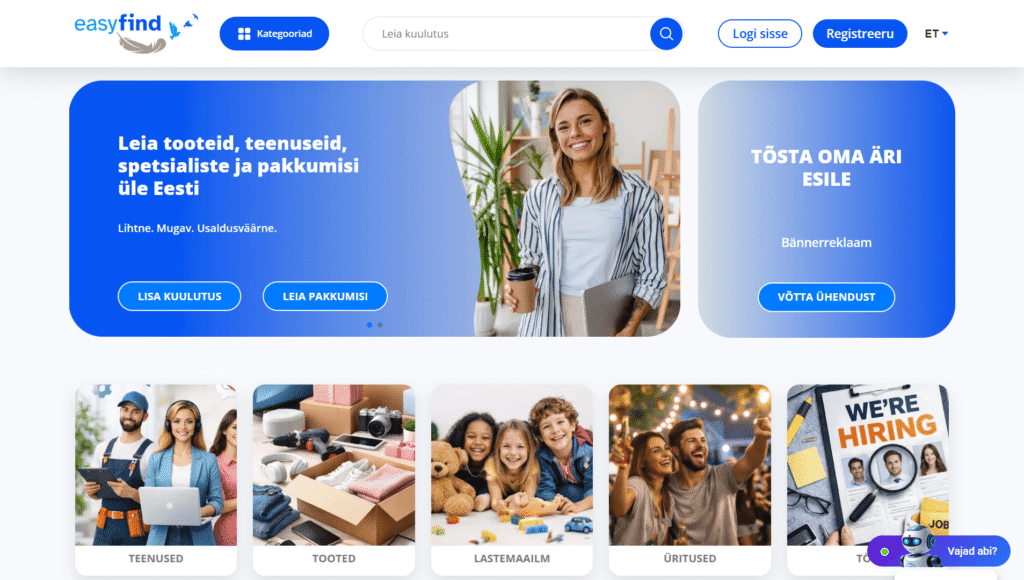
EasyFind.ee is an Estonian advertising and information portal where users can find articles, useful materials, categories, company cards, services and products from different Estonian businesses. For regular users, it is a place to find relevant information and offers. For companies, EasyFind.ee is an opportunity to become more visible, present their services and products, and in the future use paid profiles and internal advertising.
This type of project is not a regular small company website. When a business website has 5–20 pages, much of the SEO and technical structure can be planned manually. But when the project is a large portal with thousands of pages, categories, subcategories, company cards, articles, URLs, metadata, internal linking and indexing logic, the work becomes much more systematic.
Visibilion OÜ has supported the EasyFind.ee project since 2025 with SEO, technical auditing, WordPress development, website structure and independent consulting. Our role has not been simply to “make a few SEO fixes”, but to help look at the portal as a whole: how Google understands it, how users move through it, which technical limitations block growth and how development tasks should be prioritized.
This cooperation story shows why a large portal needs more than a good-looking design, published articles or isolated technical fixes. It needs a system: SEO, indexing, category logic, the WordPress technical foundation, user experience, Google Search Console data and development quality control all have to work together.
What do we cover in this cooperation story?
This article shows how Visibilion supports EasyFind.ee as an independent SEO and web development partner: from technical auditing and indexing to category structure, WordPress improvements, Google Search Console analysis and long-term cooperation.
What is EasyFind.ee?
EasyFind.ee is an advertising and information-based portal designed to bring together users, useful content, different categories and the services and products of Estonian companies. A user may arrive at the portal through an article, a search result, a category page or a company card, and then move on to the most relevant service, product or company.
The business logic of this kind of portal is different from a regular company website. A standard website often exists to present one company and generate enquiries for it. EasyFind OÜ, however, has to work on several levels at once: as an information environment for users, as a visibility channel for companies and, in the future, as a platform where paid company profiles and internal advertising can develop.
The scale of the project also makes it complex. EasyFind is not made up of a few landing pages, but thousands of pages, categories, subcategories, company information, articles and technical templates. In such a structure, SEO becomes much more than adding individual keywords to texts.
What matters is how the entire portal is built: how Google finds the pages, how it indexes them, whether categories are logical, whether metadata is unique, whether company cards give search engines a clear enough signal and whether users can quickly find what they need.
How did the cooperation begin?
The cooperation between Visibilion and EasyFind began in 2025. The management of EasyFind OÜ turned to Visibilion at a stage where the portal was already under development, but the size and technical complexity of the project created a need for an independent external perspective.
The initial task was to carry out a more detailed SEO and technical audit in order to understand the real state of the project, which parts were working, which needed improvement and which technical or structural factors could limit organic growth.
That first audit developed into a longer-term cooperation. For EasyFind.ee, it was important to have a partner who would not look only at one narrow tool or one type of task, but could connect SEO, WordPress, web development, user experience, Google Search Console data, content structure and business logic.
Visibilion’s role gradually became ongoing SEO and web development support. We helped analyze problems, set priorities, prepare technical tasks, check implementation and provide an independent view in situations where the question was not only “what should be changed?”, but also “why does this problem happen in the first place?”.
When a website does not grow, one fix is not always enough.
For a large portal or a more complex WordPress project, SEO, technical structure, indexing, page templates, URLs, content, analytics and development logic must be reviewed together. Visibilion helps identify where the system is actually getting stuck.
The challenge: a large portal needs a different SEO logic
SEO for a regular company website often focuses on service pages, blog articles, meta titles, meta descriptions, internal links and technical errors. For a large portal, all these topics are still important, but their impact depends much more on the system.
When a portal contains thousands of pages, each page cannot be managed manually. There has to be a consistent logic for page templates, categories, company cards, URLs, metadata, canonicals, noindex rules, sitemap and internal linking. If one of these layers is built incorrectly, it can affect hundreds or thousands of pages at once.
For EasyFind.ee, it was important to understand how to build the portal so that Google can understand it and users can find the information they need as quickly as possible. This meant working with technical SEO, content structure, WordPress logic and user experience.
The main challenge was not only how to get more traffic. The question was how to create a technical and content foundation for the portal that would allow organic visibility to grow gradually and support the future business model: company profiles, categories, advertising and user movement inside the portal.
Visibilion’s role: an independent SEO and web development partner
Visibilion’s role in the EasyFind.ee project was not to replace the existing development process. Our role was to provide an independent SEO, technical and structural perspective and help break down complex questions.
This distinction matters. Sometimes a company already has a website, developer, agency or internal team, but the project needs a third perspective: a person or partner who can ask the right questions, review Search Console data, check technical implementation, understand SEO logic and explain which change should be prioritized.
For EasyFind, Visibilion worked exactly as this kind of partner. We looked at the portal not only from a marketing perspective, not only from a development perspective and not only from an SEO perspective, but as a whole. For a large portal, this is especially important because the problem can be in several places at the same time: SEO logic, a WordPress template, URL structure, robots.txt file, sitemap, internal linking, the company card template or metadata generation.
Visibilion’s work was to help identify where the real problem was, what impact it could have and how to solve it in a way that would benefit not only one page, but the entire portal structure.
Technical SEO and indexing
One of the central work blocks was technical SEO. For EasyFind.ee, this meant much more than fixing a few meta titles or H1 headings. In a large portal, technical SEO has to answer questions such as: which pages should be in Google, which should not, how Google finds them, how pages are connected to each other and whether the indexing logic supports the growth of the portal.
During the work, we analyzed Google Search Console data, the indexing situation, sitemap, robots.txt logic, canonicals, noindex rules, URL structure, duplicate content risks and how Google sees different page types across the portal.
For EasyFind, it was important to distinguish between pages that should be visible in organic search and pages whose indexing may not create value. When a portal has many similar pages, categories, filters or company cards, noise can be created for Google. In this case, the goal is not to index everything, but to help Google understand which pages are important.
This work also included the logic of metadata and page templates. When a portal has thousands of pages, part of SEO must work at the template level. If a template generates incorrect titles, repeated meta descriptions or unclear headings, the problem can repeat across a large number of pages. That is why SEO for a large portal has to be systematic, not only page-by-page.
Categories, company cards and UX/UI
Another major work block was the portal structure. Categories and subcategories are very important for EasyFind.ee’s growth because they create a bridge between user intent, company offers and Google’s search logic.
If categories are too general, poorly ordered or do not match how people actually search, part of the SEO potential remains unused. If the logic of categories and company cards is unclear for the user, a person may reach the page but not continue to the relevant service or company.
Visibilion helped review the structure of categories and company cards from both an SEO and user experience perspective. The focus was on questions such as: how should a category be built, what information does the user need, how should a company card create value for both search engines and people, and what kind of internal linking helps users move through the portal more effectively.
In addition to technical SEO, we also worked on UX/UI logic: how page templates look, whether the visual structure supports user movement, whether information is placed in the right places and whether the portal structure helps people quickly understand what they can do next.
For a large portal, UX/UI is not only a design question. It directly affects whether a user finds the right category, understands the value of a company card, moves from an article to a related service and eventually reaches the right company.
Visibilion can help even when a website already has developers or an agency.
Sometimes you do not need to start from zero. You need an independent partner who reviews the existing website, finds technical and SEO problems, sets priorities and helps move development work in the right direction.
WordPress development support and technical tasks
EasyFind.ee runs on WordPress. This provides a lot of flexibility, but for a large portal it also means that every technical solution must be carefully planned. If WordPress templates, plugins, URLs, categories and content types do not work together logically, this can affect both user experience and SEO.
Visibilion’s work included technical fixes and development support both directly and in cooperation with developers. Our task was to help define what needed to be changed, why it needed to be changed and how to check whether the change solved the real problem.
In practice, this meant checking HTML and technical details in articles, analyzing URL logic, recommending structured data, improving the visual and logical structure of page templates, identifying issues that block SEO, preparing technical tasks for developers and checking completed work.
In large projects, it is very important that development does not happen blindly. Every change should support a clear goal: better indexing, a clearer category structure, better user experience, less duplicate content, more accurate metadata or better control over how Google sees the portal.
Visibilion helped maintain exactly this connection in the EasyFind project: SEO goals, technical implementation and business logic had to move in the same direction.
Three practical examples of more complex problems
To avoid staying too general, it is worth looking at three typical situations we encountered in SEO and web development for a large portal.
1. Metadata and duplicate titles
In a large portal, one technical template can affect hundreds or thousands of pages at once. If titles or meta descriptions are generated too generally, Google may see duplicate or inaccurate results. The user does not understand why they should click this exact result, and Google may not understand which page is the best match for which search.
Visibilion analyzed the metadata logic and helped define how different page types should stand out more clearly in search results. The focus was not only on making sure every page has a title, but on ensuring that the title and description support the specific category, company card or content page.
This type of work is important in a portal because optimizing every page manually is not realistic. The solution has to be partly systematic and controllable at the template level.
2. Category structure and search intent
Another important question was the logic of categories and subcategories. If a user searches for a specific service or product, they should reach a page that matches their need. If Google sees a category, it has to understand what topic it covers and for which searches it could be relevant.
Visibilion helped analyze which categories needed a clearer structure, which topics should be separated, how internal linking could support category visibility and which pages should be treated as SEO priorities.
This matters because a portal does not grow only by increasing the number of articles. A portal grows when its categories, company cards, content pages and technical templates form a clear system.
3. Where is the problem: SEO, WordPress, code or template?
The third typical situation was the need for independent diagnostics. In a large WordPress portal, it is not always immediately clear whether a problem comes from SEO settings, a WordPress template, development logic, HTML, plugin behavior, URL structure or indexing rules.
In these situations, Visibilion’s value was the whole-system view. We checked problems from several angles: Google Search Console, WordPress structure, HTML, URLs, metadata, sitemap, robots.txt, canonicals, internal linking and user experience.
This helped avoid situations where the symptom is fixed, but not the cause of the problem. If the cause is a poorly built template, manually changing one page will not help. If the cause is indexing logic, writing a new article will not solve it. If the cause is the category structure, changing only a meta title is not enough.
In exactly these situations, Visibilion works as a third and independent partner: we help when standard solutions do not bring results and the project needs a clearer technical and SEO perspective.
Results based on Google Search Console data
For EasyFind.ee, results should be assessed not only by individual keywords, but by the overall organic visibility of the portal. For a large portal, it is important how many pages Google finds, how many are indexed, how many impressions are generated and whether organic traffic is moving upward over time.
Based on Google Search Console data, EasyFind.ee has grown into a major organic visibility project. During the reviewed period, Search Console showed a total of 19.1 thousand clicks, 915 thousand impressions, 2.1% average CTR and 11.7 average position.
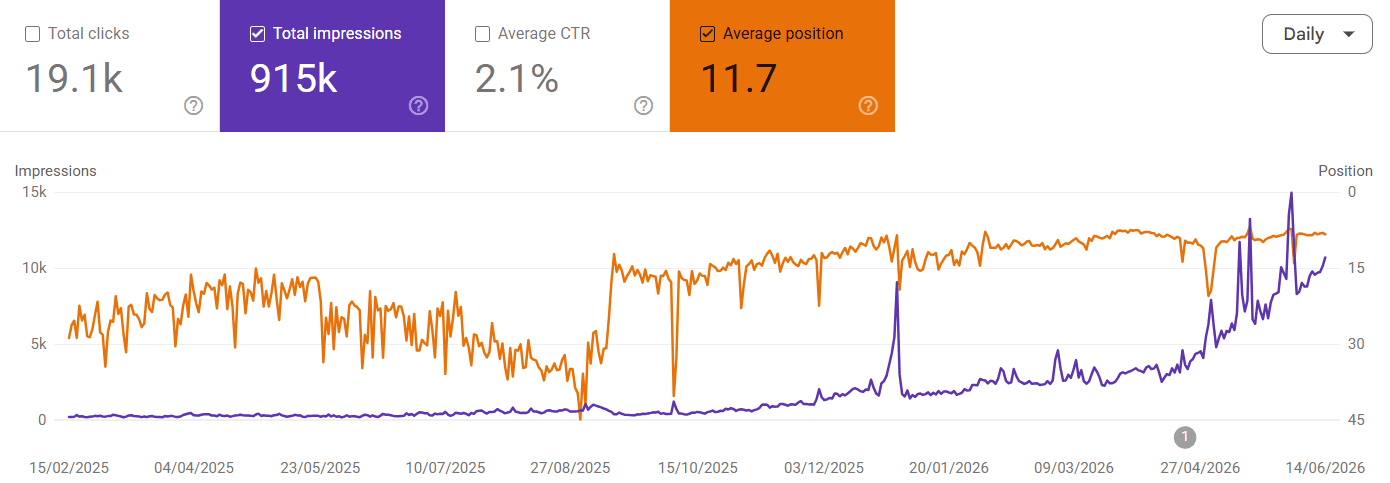
The trend is even more important. The impressions graph shows that at the beginning of 2025, organic visibility was still significantly lower, but by spring and early summer 2026, impression volume had grown to a clearly higher level. At the same time, the average position has moved toward stronger visibility.
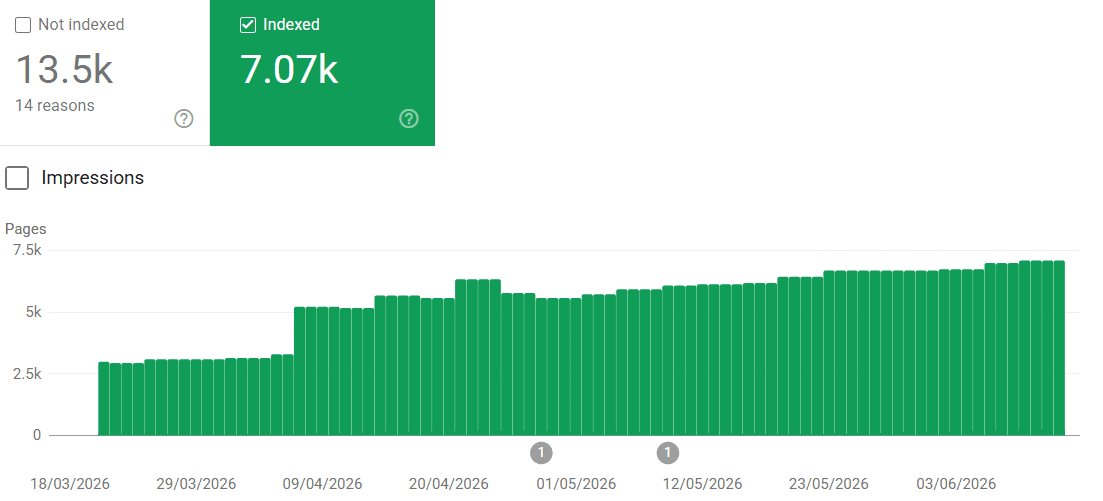
From the indexing perspective, more than 7 thousand pages are visible in Google’s index. For a large portal, this is a very important signal: SEO is no longer about individual articles or categories only, but about the entire technical structure through which Google can find, understand and display the portal’s pages in search results.
At the same time, Search Console data also shows that a large portal needs ongoing technical monitoring. When there are more than 7 thousand indexed pages and more than 13 thousand non-indexed pages, it is necessary to regularly review which pages should actually be in the index, which should not and which indexing reasons need attention.
At this scale, SEO is no longer a one-time action. It is ongoing work with indexing, page templates, categories, internal linking, metadata, URLs and technical quality.
Does your Search Console show growth or hidden problems?
Google Search Console is not just a report. It shows how Google actually sees your website: which pages receive impressions, which are not indexed, which queries bring clicks and where SEO potential may be blocked.
What does this cooperation story show?
The EasyFind OÜ cooperation story shows clearly that large web projects need more than one skill. SEO alone is not enough if the technical structure does not support indexing. Development alone is not enough if there is no clear SEO logic. Content alone is not enough if categories, URLs and company cards do not form a clear system.
Projects like this need a partner who can look at the whole. Visibilion’s role with EasyFind.ee has been exactly that: helping connect SEO, WordPress, technical audit, user experience, development support and Search Console data into one practical work process.
This case also shows that Visibilion can be useful not only when a company needs a completely new website. We can also help when a website already exists, development is ongoing, an internal team or other partners are involved, but the project needs an independent SEO and technical perspective.
This kind of role is very valuable for many companies. Sometimes everything does not need to be rebuilt immediately. What is needed is to understand what blocks growth, which problems matter most and in what order they should be solved.
For EasyFind.ee, the cooperation has been long-term and the plan is to deepen it gradually. Visibilion continues to support the project from the perspective of SEO, technical analysis, WordPress development support and digital growth.
Summary: SEO for a large portal needs a system, not random fixes
The cooperation between EasyFind and Visibilion is an example of how SEO and web development for a large portal require a systematic and long-term approach. When a website has thousands of pages, categories, company cards and technical templates, SEO is no longer only keywords or articles. It is work with the entire website structure.
Visibilion has supported the EasyFind.ee project with technical SEO, Google Search Console analysis, indexing, WordPress development support, category structure, metadata, URLs, internal linking, UX/UI and development quality control.
Our role has been to help see the whole picture and find where the portal can grow. Sometimes this means a technical audit. Sometimes it means improving category logic. Sometimes it means preparing more precise tasks for developers. Sometimes it means setting priorities based on Search Console data.
Most importantly, SEO and web development should not work separately. When they move together, a website can become not only more attractive or technically cleaner, but also a stronger business channel.
For EasyFind.ee, this work is only part of a longer process. The portal’s growth continues, and Visibilion continues to support it as an independent SEO, technical and web development partner.
Does your website, portal or development team need an independent SEO and technical perspective?
Visibilion helps companies even when a website already exists and development work is ongoing, but clarity is needed on what blocks visibility, indexing, SEO or user experience. We carry out technical audits, SEO analyses, WordPress improvements, developer tasks and help set priorities.
Write to us briefly about the website or portal and the questions that need to be solved. We will see whether to start with an SEO audit, technical analysis or development review.
See SEO service → Request an initial assessment →