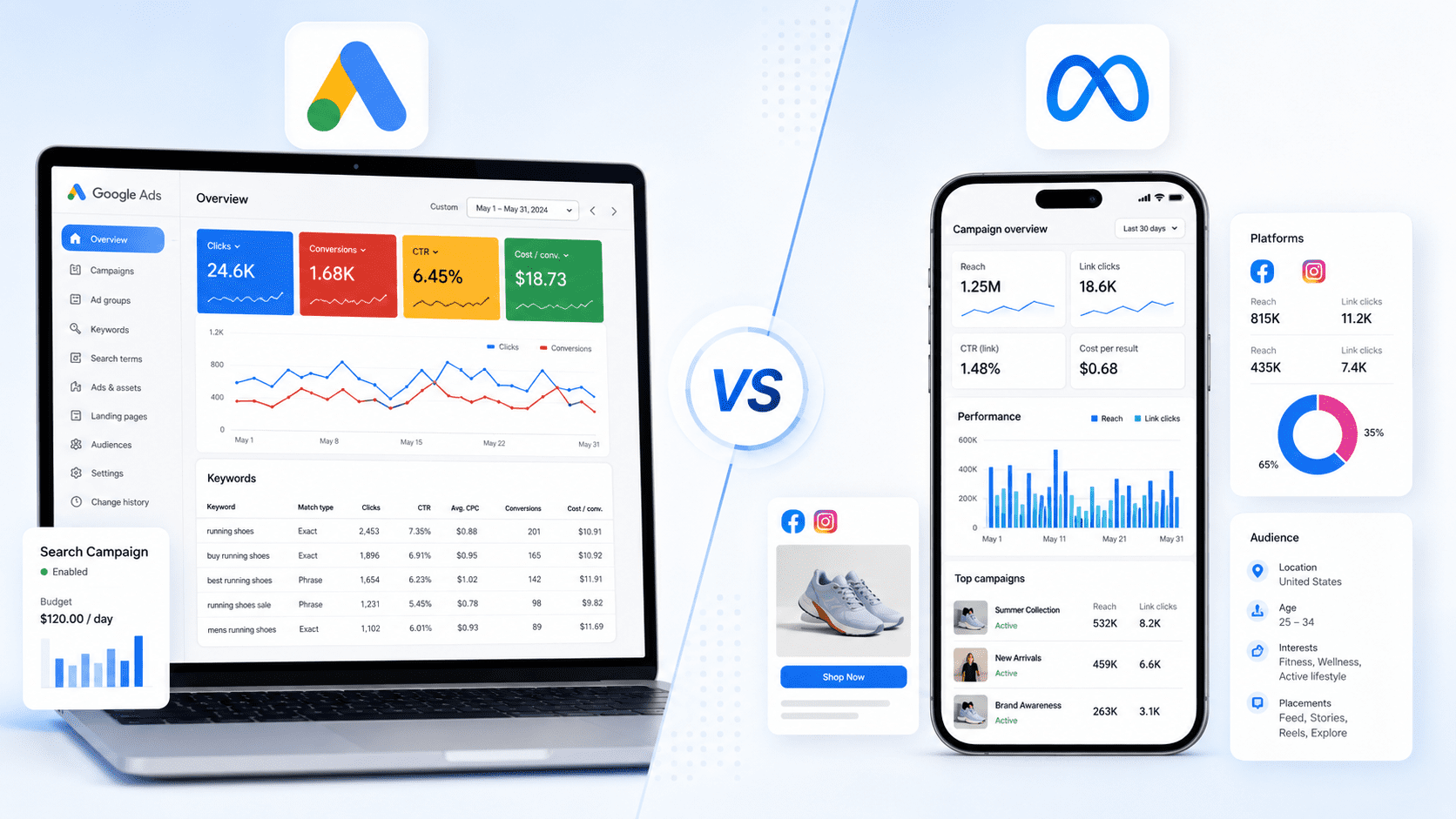
When a company starts thinking about paid advertising, it usually reaches two major options quite quickly: should it start with Google Ads or Meta Ads? One seems logical because people are already searching on Google for services, prices, and solutions. The other seems attractive because Facebook and Instagram allow you to reach a large number of people, show visuals, test offers, and grow brand awareness.
But the problem starts when these two channels are compared too simplistically. Google Ads is not just “more expensive advertising”, and Meta Ads is not just “a cheaper click”. These channels work with different logic, at different stages of the customer journey, and often with different goals.
Google Ads usually helps capture existing demand. The person is already searching for something: a service, a product, a solution, a price, a partner, or a company. Meta Ads often helps create demand, warm up the audience, or reactivate interest. The person may not be searching for anything yet, but a good ad can make them notice a problem, become interested in an offer, or return later.
That is why the most important question is not “which channel is better?”. The better question is: in which situation, with which budget, offer, website, and business goal, does your company need Google Ads, Meta Ads, or a combination of both channels?
What will you find in this article?
Here you can quickly move to the most important parts of the article and understand how Google Ads and Meta Ads differ, when each channel works better, and how to choose the right advertising channel for your company’s goals.
Short answer: Google captures demand, Meta helps create it
Google Ads and Meta Ads can both bring a company leads, sales, and new customers. But they do not do it in exactly the same way.
Google Ads works especially well when a person is already looking for a solution. For example, they type into Google “website development price”, “SEO service”, “Google advertising agency”, “accounting service in Tallinn”, “car repair shop”, or another query connected to a specific need. At that moment, the ad does not need to explain the problem to the person from zero. The need already exists.
Meta Ads works in a different environment. A person usually does not open Facebook or Instagram to find a new website developer, SEO partner, or advertising manager. They are looking at friends’ posts, reels, news, videos, stories, or simply scrolling through content. The ad has to stop their attention in that flow and only then create interest.
That is why Google Ads is often stronger when there is already active search demand in the market. Meta Ads is stronger when the company needs to grow awareness, explain the offer, show visual value, test messages, or bring website visitors back through remarketing.
To simplify: Google catches a person at the moment when they are already searching. Meta helps a person notice you before they start actively searching.
When is Google Ads a better fit?
Google Ads is especially suitable for companies whose service or product people are already searching for. This means there is demand in the market and the person uses Google to find a solution, compare prices, or choose a service provider.
For example, Google Ads can be a very strong channel for website development, SEO services, Google Ads management, accounting, legal help, medical services, car repair, construction services, B2B equipment, training, rental services, and many other services for which people make specific searches.
The main advantage of Google Ads is user intent. If a person searches for “website development for company” or “SEO service price”, they are usually further along the buying journey than a person who randomly sees an ad on social media. They may not be ready to buy immediately, but their interest is clearer.
Google Ads is a strong choice if people are actively searching for your service, you have a clear offer, a proper landing page, and you want to reach a person at the moment when they are comparing options or looking for a specific solution.
At the same time, Google Ads also has a weak point. If the keywords are commercially valuable, competition can be expensive. The cost of one click can be several euros or more, especially in services where one new customer is valuable to the company. That is why simply launching a campaign is not enough. It is important to choose the right keywords, write precise ads, exclude irrelevant searches, and direct traffic to a page that can turn a visitor into a lead.
When is Meta Ads a better fit?
Meta Ads is a good fit when a company needs to reach people before they start actively searching on Google. This is especially useful for brand awareness, visual offers, emotional messaging, remarketing, special offers, and services that are easier to understand.
In Facebook and Instagram advertising, you cannot assume that the person is already close to making a purchase decision. The ad first has to stop attention. For that, you need a strong visual, a clear message, an understandable offer, and a landing page that continues the same thought.
Meta Ads can be very useful, for example, for a local service, a new offer, a restaurant, beauty services, an event, an e-commerce product, training, employer branding, or a service that can be presented well visually. Meta is also strong in remarketing: if a person has already visited your website, you can later show them a more precise offer, a reminder, or trust-building content.
The major advantage of Meta Ads is that you can test different messages, visuals, and audiences. You can quickly see which angle stops attention, which promise creates interest, and which offer makes a person click further.
But the weak point of Meta Ads is purchase intent. Many people click out of curiosity, not because they have a clear desire to buy. That is why a Meta campaign can look successful on the surface when the click cost is low, but in reality, it may not bring enough high-quality leads. For this reason, Meta advertising should not be evaluated only by CPC. You need to look at what the person does after the click.
The main difference: user intent
Google Ads and Meta Ads differ most not by ad format, but by user intent.
On Google, a person expresses their need through a search. They type something that shows what they want to find. It can be a specific service, price, problem, solution, or company. The ad responds to that search.
On Meta platforms, the person usually does not express search intent. There, the ad has to interrupt the person’s attention flow. The ad must be clear, interesting, or relevant enough for the person to stop and think: “This may be important for me.”
| Comparison | Google Ads | Meta Ads |
|---|---|---|
| User state | Actively looking for a solution | Scrolling through content and may not be searching yet |
| Main strength | Capturing existing demand | Creating attention and demand |
| Good objective | Leads, calls, purchases, service searches | Awareness, traffic, remarketing, offer testing |
| Role of content | A clear answer to a search query | A strong visual and attention-grabbing message |
| Main risk | Expensive clicks and strong competition | Many clicks without purchase intent |
| Best use | Services and products people are already searching for | Brand, visual offers, interest creation, and remarketing |
This difference defines how the channels should be used. If you evaluate Meta advertising with the same expectations as Google search advertising, you can draw the wrong conclusions. If you expect Google Ads to warm up the brand in the same way as a Meta campaign, you may also be disappointed. The channels are not the same, and they should not be forced to do exactly the same job.
With a small budget, should you start with Google Ads or Meta Ads?
With a small budget, the most important thing is not to spread money across too many channels at the same time. If the monthly budget is, for example, 150–300 euros, testing two channels at once may give too little data. Something will happen in both channels, but not enough in either of them to make calm and useful conclusions.
If your service is searched for on Google and you have a specific landing page, I would often start with Google Ads. There you can understand faster which searches bring relevant traffic, which keywords burn the budget, and whether the offer matches the person’s search intent.
If, however, your offer is new, seasonal, visual, or needs explanation, Meta Ads may be a better first step. There you can test different messages, visuals, and angles, and see whether the market reacts to the offer at all.
A simple decision rule is this: if people are already searching for your service, start with Google Ads. If they do not yet know that they may need your offer, start with Meta Ads or use it to support Google.
Does your company need Google Ads, Meta Ads, or both?
We will review your offer, website, target audience, competition, and advertising budget.
If your ads get clicks but bring few leads or sales, we help find out whether the problem is in channel choice, messaging, landing page, or measurement.
For a B2B company, one channel may not be enough
In B2B marketing, the buying journey is often longer than in simple consumer sales. A person may see an ad on social media, later visit the website, then search for the company on Google, compare alternatives, read an article, look at a case study, and only after a few days or weeks contact you.
That is why it is not always right to see Google Ads and Meta Ads as completely separate worlds. Meta can create the first touchpoint and make the company name more familiar. Google can later capture the person when they are already in the active search phase. Remarketing can bring back those who visited the website but did not send a lead request the first time.
In B2B, you often need not just a click, but trust. The person needs to understand who you are, what you do, which problems you solve, and why it is worth talking to your company. One ad may not be enough for that.
This is where a complete system becomes important: advertising, landing page, content, cases, analytics, remarketing, and the sales process must work together. If one part is weak, it may seem that the channel does not work, although the real problem is in the offer, website, or conversion measurement.
How to choose the right channel for your company?
Before choosing an advertising channel, it is worth answering a few practical questions. They help you understand whether it is now smarter to capture existing demand or start creating it.
- Do people search for your service on Google?
- Is your offer simple and understandable, or does it need explanation?
- Do you have a landing page that matches the promise in the ad?
- Does your company already have awareness, or does trust still need to be built?
- Do you have strong visuals for Meta advertising?
- Have you set up conversion measurement?
- Do you know how much a lead or sale is financially worth to your company?
- What is your real test budget for at least 30 days?
If there are no clear answers to these questions yet, advertising should not start only from a quick campaign launch or boosting a post. First, you need to understand what exactly is being measured, who the ads are shown to, and what must happen after the click.
The choice of advertising channel should not come only from what seems popular at the moment. It should come from your business logic, customer journey, offer maturity, website quality, and measurement readiness.
When should you use both channels together?
Often, the best solution is not to choose only one channel. If the budget, website, and measurement are in order, Google Ads and Meta Ads can complement each other very well.
For example, Google Search can bring leads from people who are already searching for a specific service. Meta Ads can at the same time grow awareness, explain the problem, show client stories, offer useful content, and bring back people who have already visited the website.
In that case, the channels do not compete with each other. They perform different roles in the same sales funnel.
- Google Search helps capture high-intent searches.
- Meta Ads helps create attention, interest, and the first touchpoint.
- Remarketing helps bring back people who have already visited the website.
- Content and case studies help build trust before the lead request.
- Analytics helps understand which channel and which message actually works.
The most important thing is not to expect that one channel will fix all problems. If the offer is unclear, the landing page does not convince, or conversion measurement is missing, neither Google Ads nor Meta Ads will save the situation.
Why are the website and measurement more important than the channel?
Very often people ask: “Should we run Google Ads or Meta Ads?” But before that, they should ask something else: “Is our website ready to receive advertising traffic?”
If advertising brings a person to the website, but the website does not explain the offer, does not create trust, does not match the user’s expectation, or does not lead them to the next step, the budget starts disappearing quickly. In such a situation, it may seem that the advertising channel does not work, although the real problem is in the conversion journey.
The same applies to measurement. If conversions are not set up, form submissions are not tracked, calls are not measured, and campaigns are evaluated only by clicks, it is very difficult to understand what is really happening. The click cost may be low, but the traffic empty. The click cost may be higher, but the lead much more qualified.
That is why advertising should be viewed as a system. The channel is only one part. The offer, message, visual, landing page, trust-building content, CTA, form, analytics, and sales process after the lead are just as important.
Good advertising does not end with a click. Good advertising starts with a click and must then logically lead the person further: to understanding, trust, and eventually a lead request or purchase.
Conclusion: which channel should you choose?
Choose Google Ads if people are already searching for your service or product and you want to reach them at the moment when the need is active. It works well for services, products, and B2B solutions for which people make specific searches.
Choose Meta Ads if you want to grow awareness, create interest, test the offer, work with visual messaging, or bring back people who have already interacted with your company.
Use both channels together if you have enough budget, a proper website, clear measurement, and an understanding of which role each channel plays in the sales journey.
The best result often comes when Google and Meta do not compete with each other, but work toward the same goal through different tasks. One helps capture existing demand. The other helps create attention, trust, and new demand.
The advertising channel should not be a random choice. It should come from your business goal, customer journey, budget, website, and what you actually want to measure.
If you do not know whether to start with Google Ads or Meta Ads, let’s start with a diagnosis.
We will review your company’s offer, website, target audience, competition, advertising budget, and measurement. After that, we can decide whether it is smarter to capture existing demand with Google Ads, grow interest with Meta Ads, or build both channels into one system.
If advertising has to bring more than just clicks, the channel choice must be connected to a real business goal, landing page, and conversions.
Write to us briefly about what kind of advertising you have already run or which channel you want to start with. We will look at which next step would be the most reasonable for your company.
Ask for an initial review → View services →