Search no longer means only that a person types a keyword into Google, looks at ten blue links and chooses one result. More and more often, the user receives an answer directly in the search results, in an AI overview, conversational search, ChatGPT, Perplexity, Gemini or another AI-powered tool.
This does not mean that SEO has disappeared. On the contrary. Good SEO is still the foundation of the whole system. But website content has to do more than before. It must be findable in classic search, understandable for answer engines, usable by AI systems and trustworthy enough to be quoted, summarized or recommended.
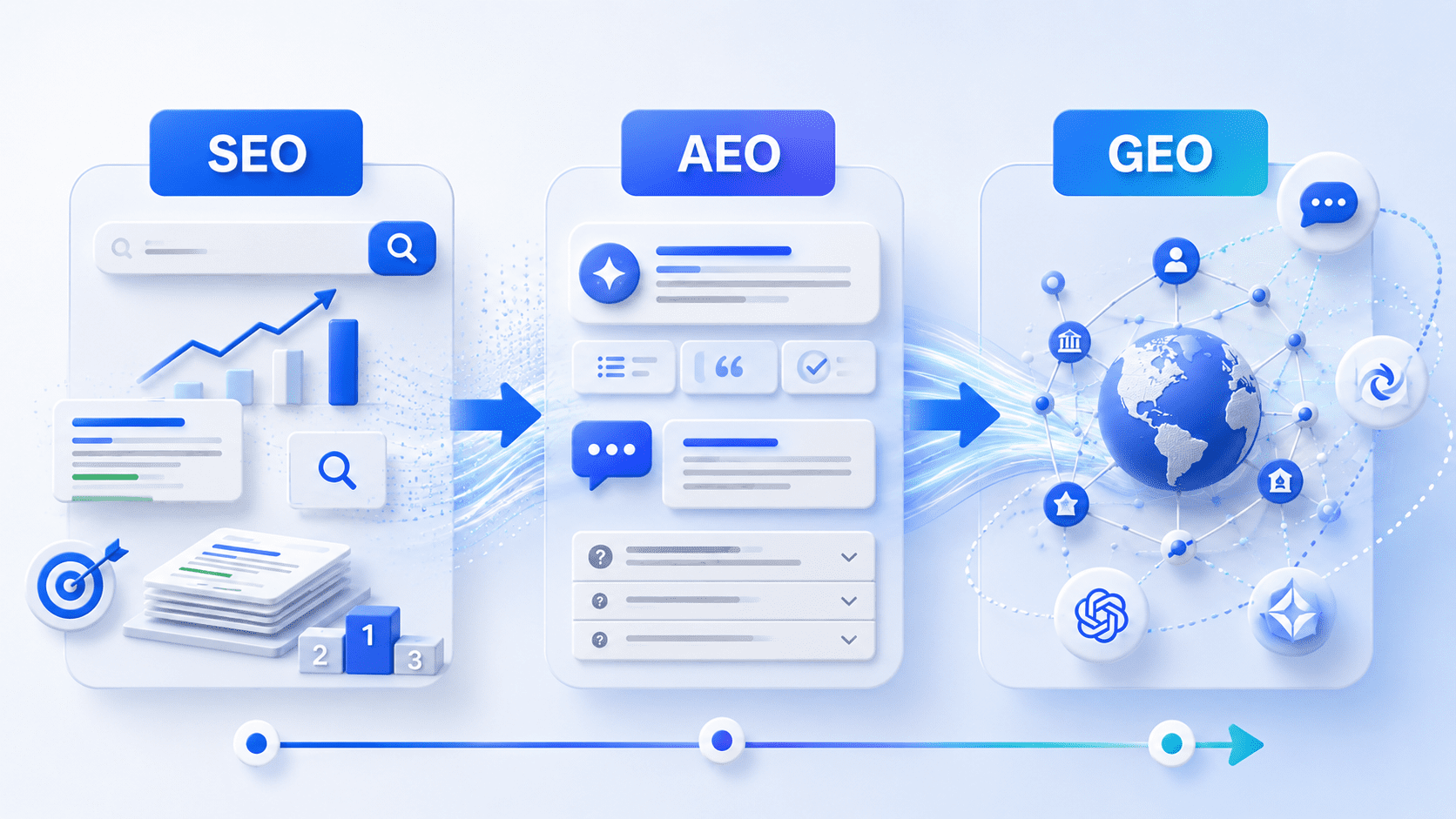
That is why people increasingly talk about three concepts: SEO, AEO and GEO. SEO, or Search Engine Optimization, helps a website become visible in search engines. AEO, or Answer Engine Optimization, helps content answer specific questions in a way that can be used for direct answers, featured snippets and AI answers. GEO, or Generative Engine Optimization, focuses on how content could become a source or recommended reference in generative AI answers.
Simply put: SEO helps you get found, AEO helps turn your content into an answer, and GEO helps your company remain visible even when the answer is created by AI.
What will you find in this article?
Here you can quickly move to the most important parts of the article and see what SEO, AEO and GEO mean, how AI search changes content creation and what a company should practically change on its website.
What are SEO, AEO and GEO?
Before rewriting website content, it is important to understand what these three concepts actually mean. New abbreviations appear quickly in marketing, and they are often used too dramatically, as if the old world had completely ended and everything had to be rebuilt from zero. In reality, the picture is calmer.
SEO, AEO and GEO are not three completely separate worlds. They are rather different layers of the same visibility system.
SEO, or Search Engine Optimization, means optimizing a website for search engines. The goal is for the page to be technically healthy, indexable, useful for the user, aligned with search intent and visible in search results. Classic SEO works with keywords, content structure, technical health, internal links, external signals, page speed and user experience.
AEO, or Answer Engine Optimization, means optimizing content for answers. The focus is not only on whether a page reaches the first page of search results, but also on whether the content answers a specific question clearly enough to be used as a direct answer. This is important for featured snippets, People Also Ask type questions, voice search, AI Overviews and other answer-based formats.
GEO, or Generative Engine Optimization, means optimizing content for generative AI systems. Here we do not think only about the classic Google result, but also about how ChatGPT, Gemini, Perplexity, AI Overviews or other generative systems find, understand, synthesize and, where possible, reference your content.
If SEO asks: “Is our page findable in search?”, then AEO asks: “Does our content give a clear answer to the question?” GEO adds a third question: “Is our content trustworthy, structured and distinctive enough for AI to use it when creating an answer?”
| Concept | What does it mean? | Main goal |
|---|---|---|
| SEO | Search engine optimization | Become visible in search results |
| AEO | Answer engine optimization | Give a clear answer to a specific question |
| GEO | Optimization for generative AI engines | Be usable as a source or reference for AI answers |
The good news is that a company does not have to choose only one. Strong content today should work with all three layers at the same time. The same article, service page or guide can be optimized for SEO, answer questions well for AEO and be trustworthy and structured enough for GEO.
Why does AI search change website content?
AI search changes how people search for information and how they consume answers. In classic search, a person often typed a short keyword: “SEO service”, “website price”, “Google Ads agency”, “metal doors”, “accounting Tallinn”. Then they had to open different results, compare them and make a conclusion themselves.
In AI-powered search, the question often becomes longer and more specific. A person does not only ask “SEO service”, but may ask: “When should a small company in Estonia start with SEO and when with Google Ads?” or “How do I understand whether my website needs SEO or a new structure?” Such a question needs not just a page that matches a keyword, but a meaningful, well-structured and trustworthy answer.
This changes the role of website content. Previously, it could be enough for a page to contain the right keywords, a service description, a few paragraphs and a contact form. Now a good page has to answer real questions: what the service means, who it is for, when it is needed, what it costs, what the price depends on, how the process works, what the alternatives are, what the risks are and how to make a decision.
AI does not need only beautiful marketing phrases. AI needs clear information that can be understood, distinguished, synthesized and, when needed, passed on to the user. That is why company websites need to become less declarative and more explanatory.
Sentences like “we offer high-quality digital marketing solutions” do not help much either the person or the AI system. It is more useful to explain which problem is being solved, who the service is suitable for, which steps are taken, which results are realistic and what the client should base their decision on.
SEO has not disappeared, it becomes the foundation layer
One big mistake would be to think that SEO is no longer needed in the age of AI search. In reality, the opposite is true. If content is not technically findable, indexable, understandable and well structured, it will be harder for it to appear in AI-based answers as well.
SEO remains the foundation layer because search engines and AI systems still need access to content. The page must load, be crawlable, contain textual content, use a logical heading structure, be connected with internal links and offer the user a good experience.
If a company website is technically weak, slow, poorly structured, thin in content and without clear service logic, AEO and GEO will not solve that problem. New abbreviations do not fix an old foundation.
From an SEO perspective, the following things still matter:
- technical health and indexability of the page;
- clear URL, title, meta description and H1 logic;
- content that matches search intent;
- logical H2 and H3 heading structure;
- internal links to related services and articles;
- fast and convenient user experience on mobile and desktop;
- unique, useful and trustworthy content;
- images with understandable file names, alt texts and context;
- structured data where it is meaningfully justified.
SEO does not disappear. SEO simply becomes less mechanical. Repeating a keyword is not enough. Content must truly help a person understand, compare or decide something.
AEO: content must answer specific questions
At the center of AEO is the question and the answer. A person does not always search for just a keyword. They want to know what something means, when something is needed, which solution is better, how much something costs, how the process works or what to consider before making a decision.
If your website does not answer these questions, someone else will. And in AI search, that “someone else” can get visibility even if their brand is not the largest. In AI answers, it is not always only the biggest company that wins. Often the opportunity goes to the source whose content answers the question most clearly, practically and reliably.
For AEO, content should be written so that the user quickly finds the answer. This does not mean that the article must be short. On the contrary, a good article can be long and thorough. But every important question must be clearly visible, and the answer must not be hidden somewhere inside general sales copy.
For example, on a service page, it is not enough to write: “We offer SEO services for companies.” From an AEO perspective, the page should also answer the following questions:
- what an SEO service is;
- who SEO is suitable for;
- when SEO is not the best first step;
- what an SEO service includes;
- how quickly results can be expected;
- what the price of SEO depends on;
- how SEO differs from Google Ads;
- how to understand whether a company needs SEO;
- which results are realistic to measure.
Such content helps the person, but it also helps search systems understand which questions the page answers. AEO does not mean only adding an FAQ block to the end of the page. It means writing the entire content so that questions, answers, explanations and decision logic are clearly visible.
Does your website content actually answer the questions your customers ask?
We review your service pages, articles, content structure, keywords, headings, internal links and conversion journey.
If the website exists, but organic visibility, AI search readiness or the number of leads does not grow, we help find out whether the problem is in content, structure, technical SEO or clarity of the offer.
GEO: content must be usable and quotable for AI
GEO, or Generative Engine Optimization, is the newest and least stable part of this topic. Here it is important to be careful, because the market already promises many miracles: “we optimize you for ChatGPT”, “we make AI recommend your company”, “we do GEO and you immediately become visible in answers”. Reality is more complicated.
Generative AI systems can create answers in different ways. Some use fresh web search and reference sources. Some rely more on the model’s previous knowledge. Some synthesize information from multiple sources. Some do not show exactly why one brand appeared in an answer and another did not. That is why GEO cannot be treated as the same kind of predictable mechanism as classic SEO, where you can see positions, queries, clicks and pages in Google Search Console.
But this does not mean that nothing can be done. The practical meaning of GEO is to make content so clear, trustworthy, structured and useful that AI systems can understand and use it more easily.
For GEO, the following qualities are especially important:
- clear definitions and short summaries;
- practical comparisons and decision frameworks;
- specific examples, not only general claims;
- authority and experience that can be seen in the text;
- transparent explanation of how conclusions are reached;
- logical structure that is easy to scan;
- data, numbers, steps, tables and processes;
- clear answers to “what”, “why”, “when”, “how” and “for whom”.
For an AI answer, the most useful content is not the content that sounds the most promotional. More useful is content that helps create an answer. If a page contains only general brand copy, it is harder to use. If a page contains definitions, explanations, comparisons, a process, examples and decision criteria, it is a much more useful source for AI.
In other words: GEO does not mean writing to please AI. It means creating such clear and useful content that both a person and AI can understand what your competence consists of.
How must website content structure change?
In the age of AI search, website content must become more structured. This does not mean that all texts must be dry, technical or only in a question-and-answer format. It means that the page must be built according to the user’s decision-making process.
An old type of service page could look something like this: a short introduction, a service description, a few benefits, a contact form. A new stronger service page should answer many more questions.
For example, a good service page could include the following parts:
- a short and clear answer to what the service does;
- who the service is suitable for;
- which problem the service solves;
- when this service is needed;
- when this service is not the best solution;
- what the service includes;
- how the process works step by step;
- what the price depends on;
- which results are realistic;
- which mistakes clients usually make;
- how to compare different service providers;
- what to know before sending a lead request;
- FAQ, or frequently asked questions;
- a clear CTA, or next step.
This may seem like a lot, but this kind of structure helps both the user and search systems. The person understands faster whether the service is suitable for them. Google can better understand which search intents the page answers. AI systems can take clearer information fragments from the page when they create an answer.
It is also important that content is not just one long wall of text. In the age of AI search, clear subheadings, short answer blocks, tables, lists, definitions, comparisons and summaries work well.
Which pages need to be changed from an AEO and GEO perspective?
First, the whole website does not need to be rewritten. It is reasonable to start with pages that have commercial or strategic value. Usually these are service pages, category pages, main articles, comparison articles, pricing pages, case studies and guides that answer questions.
From an AEO and GEO perspective, the following pages are especially important:
- Service pages, because they must explain what the company offers and why it is needed.
- Price-related articles, because people and AI systems often search for price ranges and pricing logic for decision-making.
- Comparison articles, for example “Google Ads vs Meta Ads” or “SEO vs Google Ads”.
- Question-answering articles, because they are well suited for AEO.
- Case studies, because they provide experience, examples and proof.
- Product or category pages, especially in e-commerce and B2B technical fields.
- Contact and company information, because trust and clear data become increasingly important in the visibility system.
For example, if a company offers website development, it should not have only one general service page. Alongside it, there could be articles and subpages that answer more specific questions: how much website development costs, what a good company website should be like, how long website development takes, what should be known before ordering a new website, whether to choose WordPress or a custom solution, when a simple page is enough and when a larger structure is needed.
This kind of content is not just filling a blog. It creates a topical visibility network. The better a company covers the real questions of one topic, the stronger the whole domain becomes in its clarity around that field.
Which blocks should be added to a page?
If the goal is to make content stronger for SEO, AEO and GEO, it is not enough to simply add a “Frequently asked questions” block to the end of an article. Content blocks should help the user move from not knowing to deciding.
Practically, the following blocks can be used on a company service page or in a longer article:
- Short definition: explain at the beginning what the topic means.
- Quick answer: give a 3–5 sentence summary for a person who wants a quick answer.
- When it is suitable: explain who the solution is a good choice for.
- When it is not suitable: honestly show when the solution may not be right.
- Comparison table: help the person compare different options.
- Process: describe step by step how the work is done.
- Pricing logic: explain what the price depends on, even if an exact price cannot be given immediately.
- Common mistakes: show what clients or companies often do wrong.
- Practical examples: give examples from real situations.
- FAQ: answer specific frequently asked questions.
- Next step: say clearly what the person can do next.
This structure helps the page cover both informational and commercial search intent. A person who is only learning the topic gets answers. A person who is already closer to a buying decision understands whether it is worth contacting the company.
For AI search, blocks that contain clear definitions, comparisons and step-by-step explanations are especially useful. These are formats that are easy to summarize and use as an answer.
Technical side: what should be checked in the age of AI search?
Although AEO and GEO sound like content topics, the technical side cannot be ignored. If a search engine or the source-finding mechanism of an AI system cannot access the page, the content cannot become visible either.
Technically, at least the following things should be checked:
- whether the page is indexable in Google;
- whether robots.txt does not block important pages;
- whether the page returns the correct 200 status;
- whether important content exists as text in HTML, not only in an image or hidden by a script;
- whether the H1, H2 and H3 structure is logical;
- whether pages have unique titles and meta descriptions;
- whether internal links help important pages be found;
- whether structured data matches the visible content;
- whether images have reasonable file names and alt texts;
- whether the page works well on mobile;
- whether contact details and company information are up to date;
- whether language versions on a multilingual website are connected correctly.
Textual content is especially important. If important information is only inside an image, a PDF or a complex interactive block, it may be harder to understand and use. In the age of AI search, important information should be present on the page as clear text, under logical headings and connected with other relevant pages.
Structured data can help search engines better understand page content, but it should not be a trick. Schema markup must match visible content. If the page does not actually have FAQ, reviews, a product or article data, they should not be added artificially only to “please” search.
What should you not do with AEO and GEO?
When a new trend becomes popular, bad practice appears quickly as well. The same happens with AEO and GEO. Companies may start producing large amounts of low-quality “AI optimized” texts that repeat the same definitions, answer questions superficially and do not actually add anything new.
This should be avoided. In the age of AI search, we do not need more empty content. We need better content.
With AEO and GEO, you should not do the following:
- write only for AI and forget the real user;
- artificially fill the page with questions that no one actually searches for;
- create dozens of very similar articles without new value;
- use the terms AEO and GEO only as a sales trick;
- promise that content will definitely appear in ChatGPT or AI Overviews answers;
- add structured data that does not match visible content;
- copy competitors’ content and hope that it is enough;
- hide important information only in PDFs or images;
- write general statements without examples, process and decision logic.
The biggest mistake is to think that AEO or GEO is a quick technical trick. In reality, it is more of a systematic improvement of content quality, structure, trustworthiness and visibility.
If your content is not useful for a person, it will probably not suddenly become valuable only because a few AI-related keywords are added to it.
Practical checklist for a company website
If you want to evaluate whether your website content is ready for the age of AI search, start with a simple check. Take one important service page or article and answer the following questions.
- Is it quickly clear at the beginning what the page is about?
- Does the page answer a specific search intent?
- Does the page have clear H2 and H3 subheadings?
- Does the content answer the questions that customers actually ask?
- Does the page have a short definition or summary?
- Does the page explain who the solution is suitable for and who it is not suitable for?
- Are there comparisons, examples or decision criteria?
- Is the price or pricing logic at least generally explained?
- Is the process described step by step?
- Does the page include the company’s real experience, not only general copy?
- Does the user understand what the next step is?
- Do internal links lead to related services and articles?
- Is important information present as text on the page?
- Do images have clear alt texts?
- Can the page be measured in Google Search Console and Analytics?
If most answers are “no”, it does not mean that the page is bad. It means that the page has room for development. Often, everything does not need to be redone from zero. It is enough to restructure existing content, add missing answers, improve headings, bring in practical examples and connect the page better with the entire website system.
In the age of AI search, the companies that win are probably not the ones that write the most, but the ones that answer the best.
Conclusion: how does content actually change in the age of AI search?
AEO, GEO and SEO do not mean that every company has to rebuild its marketing from zero. But they do mean that website content must become clearer, more useful, more structured and more supportive of the decision-making process.
SEO still remains the foundation. Without technically healthy, indexable content that matches search intent, it is difficult to achieve visibility in AI-based search experiences as well.
AEO adds the need to answer questions clearly. Content must be built so that the person quickly finds the answer and the search system understands which question the page answers.
GEO adds the generative dimension. Content must be trustworthy, distinctive and well structured enough for AI systems to understand, synthesize and, where possible, use as a source.
Practically, this means that a company website can no longer be only a digital business card. It must be a system of knowledge, answers, trust and decision-making. Service pages must explain. Articles must answer real questions. Case studies must show experience. Internal links must connect topics into a whole. Technical SEO must ensure that content is findable and usable.
The most important change is in mindset. Previously, many companies asked: “Which keyword do we want to rank for in Google?” Now they should also ask: “Which questions should our company be the best answer to?”
If you can answer those questions better than competitors, your content will not work only for classic SEO. It will also work for answer engines, AI search and real people who ultimately want to make a better decision.
If your website content was written for the old search era, it is worth reviewing it now.
We review your service pages, articles, content structure, technical SEO, internal links and conversion journey. The goal is not simply to add more text, but to make content better at answering users’ questions, supporting search visibility and being ready for AI-powered search.
If you want to understand which pages should be improved first, we can start with a practical SEO, AEO and content audit.
Write to us briefly about which website or content structure you want to improve. We will see whether to start with service pages, articles, technical SEO or rebuilding the whole content plan.
Ask for an initial review → View services →