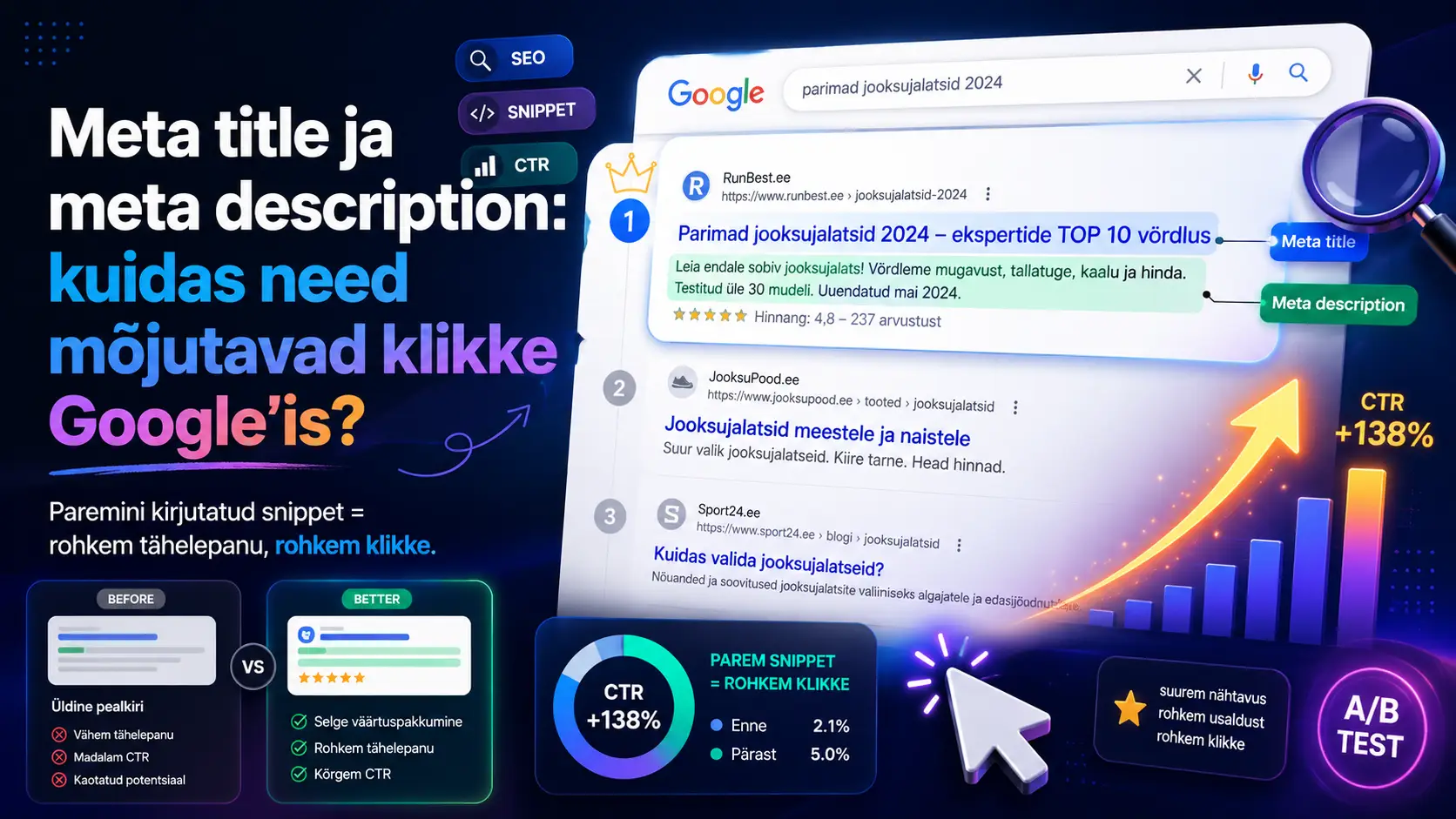
Meta title and meta description are small but very important elements of SEO for every website. They are usually not visible to the user on the page itself in the same way as normal text, but they can influence how the website appears in Google search results. When a person sees several results in search, they often decide which page to click based on the title and description.
A good meta title helps the user quickly understand what the page is about. A good meta description gives an additional reason to click on that result. If they are too generic, confusing or automatically generated, the website may lose valuable clicks even when it already has a fairly good position in Google. That is why metadata should not be treated only as a technical SEO detail. It is part of the website’s sales copy in Google search results.
It is important to understand that meta title and meta description do not work alone. Clicks are also affected by the position in Google, brand awareness, search intent, competitors’ messages and the user’s need. However, well-written metadata can improve CTR, or click-through rate, and help get more visits from the positions the website already has.
What is a meta title?
A meta title is the page title that Google may display in search results as the blue clickable headline. It is also often used as the browser tab title and when sharing the page on social media if a separate Open Graph title has not been set. From an SEO perspective, it is one of the most important elements that helps both the search engine and the user understand what topic the page is related to.
The meta title is not always the same as the page’s H1 heading. H1 is the main visible heading inside the page. The meta title, however, is written for the search result. They can be similar, but they do not have to be identical. For example, the H1 can be more natural and longer, while the meta title should be compact, precise and click-oriented.
A good meta title should include the main keyword of the page, but it should not simply be a list of keywords. If the title sounds unnatural or too technical, the user may not click on it. The title has to combine SEO with clear value for a real person.
For example, a poor meta title could be:
SEO, SEO service, SEO optimization, Google SEO
This is overloaded with keywords and does not give the user a clear reason to click.
A better version would be:
SEO service for companies in Estonia – visibility in Google | Visibilion
This title says what service is being offered, who it is suitable for and what benefit it provides.
What is a meta description?
A meta description is a short description that Google may display under the title in search results. Its purpose is to explain what the user will find on the page and give them a reason to click. A meta description is not just a “sales line” in the advertising sense, but a short promise about what information or value the page offers.
Although Google may not always show exactly the meta description written by the website owner, it is still important. If the description is well written and matches the search query, there is a higher chance that Google will use it or at least part of it. If there is no meta description, Google may take a random text fragment from the page, which may not be the most convincing or the best in terms of context.
A good meta description should be specific, understandable and connected to the user’s need. It does not have to repeat the meta title exactly, but should complement it. If the title says what the page is about, the description explains what the user gets or why the page is useful.
For example, for a page about Google Ads problems, a weak description could be:
An article about Google Ads. Read more in our blog.
This is too generic and does not explain why the user should click.
A better version would be:
Google Ads does not bring inquiries? See 7 common reasons why ads do not work: wrong traffic, weak landing page, poor CTA, missing tracking and unclear offer.
This description is specific, connects the topic with the user’s problem and promises a practical answer.
How do meta title and meta description affect CTR?
CTR, or click-through rate, shows what share of people click on a search result after seeing it. If a page appears in Google 100 times and receives 5 clicks, the CTR is 5%. CTR depends on many factors, but meta title and meta description play an important role because they are the first texts the user sees in the search result.
If a website has a good position in Google, but the title is boring or unclear, the user may choose a competitor’s result. In the same way, a page in a lower position can receive more clicks if its title and description answer the user’s question better. This does not mean that metadata replaces SEO, but it helps use existing visibility more effectively.
For example, if someone searches for “website development for companies”, they compare the results very quickly. If one result simply says “Websites”, while another says “Website development for companies in Estonia – clear structure, SEO and inquiries”, the second result gives the user more information and probably feels more relevant.
Metadata affects clicks mainly in three ways. First, it helps show that the page matches the search intent. Second, it helps stand out from competitors. Third, it gives the user a promise: what they will get from the page if they click.
A good meta title and meta description do not have to be aggressive. They need to be precise, useful and interesting enough for the user to choose that result.
Does meta description affect Google ranking?
Meta description is usually not a direct ranking factor in the same way as page content, technical quality or links. This means that changing only the meta description may not move the page higher in Google. However, a good meta description can affect the number of clicks because it makes the search result more attractive to the user.
If the page receives more relevant clicks, it can indirectly support SEO performance, especially if users stay on the page, read the content and continue browsing. But the main job of the meta description is not to “please Google”. Its main job is to help the user understand whether this page matches their need.
Meta title is more important for SEO than meta description because it helps the search engine better understand the topic of the page. That is why the main keyword or topic should be as clear as possible in the title. At the same time, this should not happen at the expense of readability. If the title is written only for the search engine and not for a human being, the number of clicks may suffer.
In practice, this means that metadata should be written for both Google and the user. The title should be relevant to the topic and connected to the keyword. The description should be convincing, specific and aligned with the user’s search intent.
Google may not always display your metadata
One important thing many website owners do not know is that Google can rewrite the meta title or meta description in search results. This means that even if you have written a very good title and description for your page, Google may not always show them exactly in that form.
This can happen for several reasons. For example, if Google finds that your meta title does not match the user’s search well enough, it may use the page’s H1 heading or another piece of text. If the meta description is too generic, too short, too long or does not fit a specific query, Google may choose a more suitable fragment from the page content.
This does not mean that there is no point in writing metadata. On the contrary, well-written metadata increases the chance that Google will use it. In addition, it helps better control how the website is represented in search results.
To reduce the chance of Google rewriting it, it is worth making sure that:
- the meta title matches the actual content of the page;
- the title is not too long or overloaded with keywords;
- the meta description accurately describes the page’s value;
- the H1 and meta title do not contradict each other;
- the page content supports the same topic that the metadata promises;
- every important page has unique metadata.
Google may change metadata, but the website owner should still provide the best possible version.
We help make your Google results more clickable.
We review meta titles, meta descriptions, SEO structure and Search Console data.
How long should a meta title be?
A meta title should be short enough to display clearly in search results, but meaningful enough for the user to understand the topic of the page. In practice, it is usually worth keeping the meta title within about 50–60 characters, but this is not an absolute rule. Google displays titles based on pixel width, not only the number of characters, so some letters and words take more space than others.
A title that is too long may be cut off in search results. If the most important information is at the end of the title, the user may not see it at all. That is why the most important keyword or message should be placed at the beginning of the title. The brand name can be added at the end, especially on service pages and blog articles.
For example:
Website development for companies in Estonia | Visibilion
This is clear and compact. The user immediately sees what the page is about.
A weaker version would be:
Visibilion offers a professional and high-quality website development service for all companies in Estonia
This is too long, the main keyword is not focused enough and an important part may be cut off in the search result.
When writing a good title, it is worth thinking not only about length, but also about priority. What is the most important information the user needs to see? What makes this page different from other results? What helps get the click without exaggeration?
How long should a meta description be?
A meta description should usually stay within about 140–160 characters. This is also not a strict technical limit, because Google may display the description differently depending on the device, query and search result format. If the description is too long, it may be cut off. If it is too short, it may not provide enough information.
A good meta description should fit into a short format, but still be strong in meaning. It can include the main topic, user benefit and, if needed, a call to action. At the same time, not every description has to end with a classic CTA such as “contact us”. For a blog article, “read how…” may work better; for a service page, “we help companies…” may be more appropriate; and for a category page, “explore solutions…” may be enough.
For example, a blog article meta description:
Meta title and meta description affect how your website appears in Google. Read how to write titles and descriptions that bring more clicks.
This description explains the topic and promises practical value.
A service page description could be more commercial:
Visibilion helps companies improve SEO, optimize meta titles and meta descriptions and increase the number of clicks from Google search.
When writing the description, it is worth avoiding empty phrases such as “best service”, “quality solution” or “professional team” if they are not connected to specific value. The user wants to know what they will get from the page.
How to write a good meta title?
A good meta title starts with a clear topic. If the page is about an SEO service, that should be visible in the title. If the page is about website development, that should also be at the beginning of the title. In search results, users read titles quickly, so the main topic must be immediately understandable.
The second important part is differentiation. If all competitors use the title “SEO service”, it may be useful to add clarification: who the service is for or what benefit it provides. For example, “SEO service for companies in Estonia – visibility in Google” is much clearer than simply “SEO service”.
The third part is naturalness. A meta title should not feel robotic. The keyword is important, but the title must be readable and trustworthy. Too many keywords in one title can feel spammy and reduce clicks.
A good meta title formula can be:
Main keyword + value or clarification + brand
Examples:
- Google Ads service for companies in Estonia | Visibilion
- Website development for companies in Estonia | Visibilion
- SEO audit: how to find website growth opportunities? | Visibilion
- Meta title and meta description: how to get more clicks?
Not every title has to follow the same structure, but it should be clear, precise and connected to the user’s search.
How to write a good meta description?
A good meta description complements the title. If the title says what the page is about, the description explains why the page is useful to the user. The best description answers the user’s silent question: “Why should I click on this result?”
When writing the description, it is worth thinking about search intent. If the person is looking for information, the description should promise an explanation, guide or practical answer. If the person is looking for a service, the description should explain what the company offers and what benefit the client receives. If the person is comparing solutions, the description can emphasize clarity, experience or specific value.
For example, for an informational article:
Google Ads does not bring inquiries? See 7 common reasons why campaigns do not work and learn what to check before increasing the budget.
For a service page:
We help companies set up and manage Google Ads campaigns that focus on inquiries, sales and measurable results.
Both descriptions are more specific than “read our article” or “we offer professional service”. They give the user a reason to click.
When writing a meta description, it is worth checking:
- whether the description matches the page content;
- whether the main topic is clearly mentioned;
- whether the user understands what they will find on the page;
- whether the text is natural and not over-optimized;
- whether the description is different from other similar pages;
- whether it contains clear value or a reason to click.
Common mistakes with meta titles and descriptions
On many company websites, metadata is either missing, too generic or automatically created. This is a wasted opportunity because every important page could work better in search results. If metadata is not optimized, Google may display random text, or competitors may get more clicks simply because their wording is better.
One common mistake is using the same meta title and description on several pages. For example, if all service pages have the title “Services | Company name”, neither the user nor the search engine can quickly understand how these pages differ. Every important page should have its own unique title and description.
Another mistake is keyword stuffing. A meta title is not the place to include every possible search phrase. If the title sounds unnatural, the person may not click on it. Google may also rewrite such a title.
A third mistake is a description that is too generic. For example, “Our company offers quality services at the best price” tells the user almost nothing. It is much better to describe a specific service, problem or benefit.
Common mistakes include:
- meta title and description are missing;
- all pages have the same metadata;
- the title is too long or too short;
- the description is too generic;
- the main keyword is missing;
- the text is overloaded with keywords;
- the title promises something the page does not offer;
- the brand takes up too much space in the title;
- metadata is not updated after the page content changes.
Optimizing metadata is not complicated, but it requires thoughtful wording and an understanding of what the user actually needs in search.
How to check whether metadata works?
The effect of metadata can be evaluated with Google Search Console. There you can see which queries display the page in Google, how many impressions it receives, how many clicks it gets and what the CTR is. If a page has many impressions but a low CTR, one reason may be a weak meta title or meta description.
Of course, CTR alone does not explain everything. Low CTR may also be caused by a low position, many ads in the search results, Google showing the answer directly on the results page or search intent not being quite right. Still, improving metadata is often one of the simplest ways to use existing visibility more effectively.
A practical process could be this: choose pages in Google Search Console that have many impressions but low CTR. Check which queries those pages appear for. Then check whether the meta title and description match those queries. If not, rewrite them so they are clearer, more precise and more attractive to the user.
After making changes, results should not be judged the next day. Google may need time to take the changes into account. Usually, it is worth comparing data over several weeks or months, depending on the traffic volume of the page.
During the check, it is worth looking at:
- which pages have many impressions;
- which pages have low CTR;
- which search queries the page appears for;
- whether the title matches the intent of the query;
- whether the description gives enough reason to click;
- whether competitors’ results seem stronger;
- whether Google displays your written description or changes it.
Metadata optimization is an ongoing process. The first version does not always have to be the final one.
Metadata on service pages and blog articles
Metadata for service pages and blog articles should be written with slightly different logic. The goal of a service page is to bring a potential customer closer to the service. The goal of a blog article is often to answer a question, explain a problem or bring the user to the website at an earlier decision-making stage.
A service page meta title should usually include the service name and, if needed, the location or target audience. For example, “Website development for companies in Estonia | Visibilion” is a clear service page title. The description should explain what the company offers and what benefit the client receives.
A blog article title can be more in the form of a question or problem. For example, “Why Google Ads does not bring inquiries? 7 common reasons” works well because it responds to a specific pain point. The description can promise a practical explanation and show what the article covers.
Service page metadata should match buying or inquiry intent. Blog article metadata should match informational search intent. If these are mixed up, the result may be weaker. For example, a meta description that is too sales-focused on an informational article may reduce trust. A description that is too soft and generic on a service page may not bring enough inquiries.
A good practice is to think separately for each page:
- is the user looking for information or a service;
- what decision-making stage they are in;
- what problem they want to solve;
- which wording makes this page different from competitors;
- what the logical next step is.
When metadata matches the purpose of the page, it works much better.
Summary: meta title and meta description are small details with a big impact
Meta title and meta description are small elements, but their impact can be noticeable. They help determine how the website appears in Google search results and whether the user decides to click. Even a good position in Google does not deliver the maximum result if the title is unclear or the description does not provide enough reason to click.
A good meta title is precise, natural and connected to the main topic of the page. A good meta description complements the title, explains the user benefit and matches search intent. Both should be unique, understandable and written for a person, not only for the search engine.
Optimizing metadata does not mean using tricks. It means clearer communication. If a company can explain better in Google search results what it offers and why it is useful to the user, the same visibility can bring more clicks, more visits and eventually more inquiries.
We improve your visibility and the quality of your clicks.
Write to us if you want to understand why your pages are visible in Google but do not bring enough clicks or inquiries.