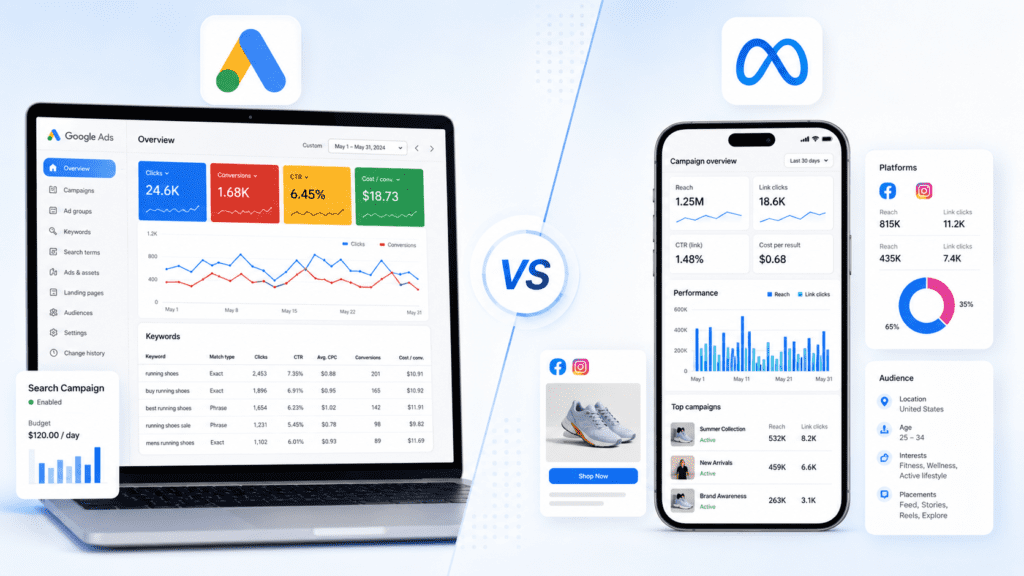
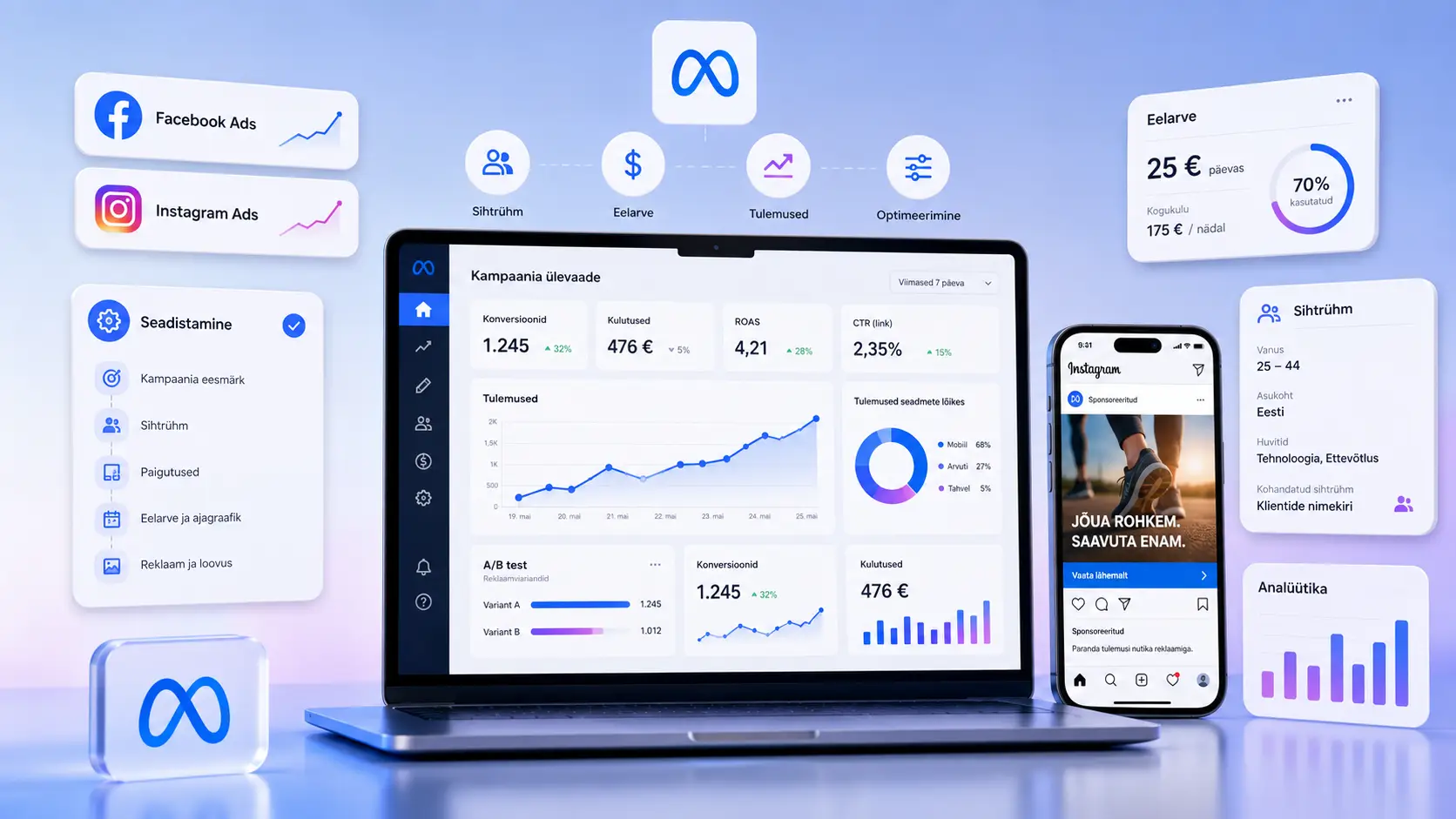
Meta advertising, meaning Facebook and Instagram ads, can be a very strong channel for increasing a company’s visibility, enquiries and sales. If Google Ads helps reach people who are already searching for a specific service or product, Meta Ads allows you to reach people earlier: at the moment when they are only noticing a problem, comparing options or have not yet actively started searching on Google.
That is why Meta ads are especially useful for companies that need to grow demand, introduce an offer, bring people to a landing page, collect enquiries, run remarketing or support brand awareness. At the same time, launching Facebook ads or Instagram ads does not automatically mean that enquiries will immediately start coming in. As with any digital marketing channel, the result depends on how well the audience, message, visual, offer, landing page, measurement and campaign management are set up.
If a company searches Google for phrases such as “facebook ads cost”, “meta advertising”, “meta ads”, “instagram marketing”, “facebook ads management” or “meta ads agency”, it usually has a very practical question: how much does it cost, what is done for that money and can the ads actually bring new customers?
In this article, we will look at what Meta advertising for a company means, how Facebook and Instagram ads work, what the cost depends on, what setup and management include, and why a professional approach helps avoid a situation where the advertising budget is spent but enquiries or sales do not come in.
What will you find in this article?
Here you can quickly move to the most important parts of the article and see how Meta advertising, Facebook, Instagram, Threads, audiences, visuals, landing pages and conversion measurement work together.
What is Meta advertising?
Meta advertising means ads on Meta platforms, mainly Facebook and Instagram. Meta ads can be used for different goals: increasing visibility, bringing traffic to a website, collecting enquiries, supporting sales, advertising e-commerce products, remarketing or testing a new offer.
Many people still call it “Facebook advertising”, although in practice the advertising system also includes Instagram and other Meta placements. When a company talks about Facebook ads, Instagram ads or Meta ads, in most cases it means the same advertising environment where campaigns can be created, audiences selected, visuals tested and results measured.
The strength of Meta advertising is that it does not depend only on what a person searches for on Google. Ads can be shown to people based on their interests, behaviour, location, demographic characteristics, website visits or similar audiences. This means that Meta Ads fits well in situations where the customer may not yet be actively searching for the service, but may be receptive to a good offer at the right moment.
For example, Meta advertising can work well:
- for a local service provider;
- when advertising e-commerce products;
- when promoting events and campaigns;
- for restaurants, beauty services and entertainment;
- in offers related to real estate, interior design and construction;
- in remarketing for B2B companies;
- for employer branding and recruitment campaigns;
- when introducing a new brand, service or offer.
Meta advertising is not only “boosting a post”. A professionally set up Meta Ads campaign is a thought-through system where the goal, audience, ad, visual, text, landing page and measurement work together.
Facebook ads or Instagram marketing
Facebook and Instagram are often used differently, but in advertising management they can be treated as one system. In some fields, Facebook works better; in others, Instagram. Sometimes one brings more clicks, the other more enquiries. Sometimes the difference is not in the platform, but in the ad format, visual, offer or audience.
Facebook can be stronger when the audience is older, the decision needs more information or the service is more practical. Instagram can work better for visual products, lifestyle, services, brand, inspiration and capturing attention faster. At the same time, this should not be taken too rigidly. Many people use both platforms, and the Meta system can itself find where the ad performs better based on campaign results.
It is important to understand that Instagram marketing does not only mean publishing beautiful posts. If the goal is enquiries or sales, you also need to think about the advertising funnel: who sees the ad, what the person sees, where they move next and what action is expected from them.
Meta advertising can support both Facebook and Instagram marketing, but advertising does not replace a good offer, trust-building content or a clear customer journey.
What about Threads? Is it also part of Meta advertising?
Yes, Threads is also part of the Meta advertising ecosystem. While Meta ads used to mainly mean Facebook and Instagram, today Threads must also be considered as one possible ad placement. In Meta’s advertising environment, campaigns can be expanded to different placements, and the Threads feed can be one place where the ad reaches the user.
For a company, this means that Meta advertising should not be viewed only at the level of a Facebook post or Instagram story. It is a broader system where ads can be shown in different environments: Facebook, Instagram, Messenger, Threads and the Meta Audience Network. Which placements are suitable in a specific case depends on the campaign goal, audience, creative materials and measurement.
Threads can be interesting especially when the company’s message fits a more conversational, opinion-based or community-oriented format. At the same time, the existence of a new placement does not mean that the entire budget should automatically be directed there. It is important to test, measure and see which placements actually bring quality traffic, enquiries or another business result.
You can also read about Threads ads in Meta’s official overview of Threads ads.
When is Meta advertising a good choice for a company?
Meta advertising is a good choice when a company wants to reach people with a more visual and active message. While Google Ads often responds to an existing search, Meta advertising helps create demand, grow interest and bring the person back again.
Meta advertising is especially suitable when:
- the company has a visually understandable service or product;
- the offer can be presented briefly and convincingly;
- the audience can be clearly defined;
- the company wants to grow awareness;
- traffic needs to be brought to a landing page;
- enquiries or contacts need to be collected;
- an e-commerce store needs sales and remarketing;
- the company has social proof, images, videos or customer examples;
- Google Ads, SEO or offline sales need support.
Meta advertising can also be very useful when a company does not want to wait until SEO results grow, or when Google search volume is small. In some fields, people do not search for the service every day on Google, but they may respond well to a timely ad that shows a problem, solution or specific offer.
For example, a construction company can advertise a specific seasonal service. A beauty salon can advertise a new procedure. A restaurant can advertise a lunch offer or event. An e-commerce store can advertise a product category or discount campaign. A B2B company can use Meta advertising for remarketing to stay visible to people who have already visited the website.
Meta advertising does not work alone
One common mistake is to think that the ad itself must do all the work. In reality, advertising is only one part of the journey. When a person sees an ad, clicks and reaches the website, the page must convince them. If the ad collects enquiries through a form, the form must be simple and the offer understandable. If the goal is sales, the purchase journey must be smooth.
The result of Meta advertising usually depends on the following parts:
- audience;
- advertising goal;
- visual or video;
- ad copy;
- offer;
- landing page;
- CTA;
- form;
- tracking and analytics;
- regular campaign optimization.
If one part is weak, the result of the entire campaign can suffer. For example, a very good ad can bring many clicks, but if the landing page is confusing, enquiries will not come. Or a strong landing page may remain unused if the ads reach the wrong audience. Or enquiries may come, but they cannot be evaluated because conversion measurement has not been set up correctly.
That is why Meta advertising must be viewed as a whole, not only as numbers in Ads Manager.
Facebook ads cost
When a company searches for “facebook ads cost”, it usually wants to know two things: how much needs to be paid as the advertising budget and how much campaign setup or management costs. These are two different costs.
The advertising budget goes to the Meta platform. It is used to show ads and get clicks, views, enquiries or other results according to the campaign goal.
The setup and management fee goes towards the work. It includes strategy, campaign structure, audiences, ad copy, preparation of visuals, testing, measurement, optimization and analysis of results.
The cost of Facebook and Instagram advertising depends on several factors:
- competition in the field;
- the size of the audience;
- the goal of the ad;
- the quality of visuals and messages;
- the strength of the offer;
- the landing page;
- seasonality;
- the history of the ad account;
- whether it is a cold audience or remarketing;
- how well the campaign is optimized.
If the ad is irrelevant to people, the visual is weak or the offer is unclear, the cost can become higher and the result worse. If the message is precise, the visual stops attention and the landing page supports the next step, the same budget can produce a better result.
How large should the Meta advertising budget be?
The Meta advertising budget depends on the goal. A small test can start modestly, but with too small a budget, the campaign may not collect enough data to make the right conclusions.
A very minimal test budget could be around 5 euros per day, or approximately 150 euros per month. Such a budget may be suitable for testing a small offer, a simple campaign or remarketing. At the same time, it should be considered that 150 euros per month is more of a minimum than a comfortable working budget in many fields.
A more practical starting budget could be around 10–20 euros per day, or approximately 300–600 euros per month. With this budget, it is already easier to test different ad texts, visuals, audiences and landing pages. If the goal is sales, a larger campaign, several audiences or an e-commerce store, a reasonable budget may be 1000 euros per month or more.
When planning the budget, it is worth thinking about:
- how much one new customer is worth to the company;
- the size of the average purchase or contract value;
- how many enquiries or sales are needed;
- how well the sales process closes enquiries;
- whether the goal is awareness, traffic, enquiries or sales;
- whether the ad sends the person to a website or collects the enquiry directly through a form;
- how much testing of visuals and messages is needed.
It is important not to evaluate Meta advertising only by click cost. A cheap click does not automatically mean a good result. Much more important is how much a quality enquiry, purchase or new customer costs.
In addition to the advertising budget, it is worth considering the workload of campaign setup and management. The advertising budget goes to the Meta platform, but campaign strategy, audience definition, ad copywriting, visual testing, Meta Pixel and conversion logic and regular optimization are separate work. This is what determines whether advertising brings random attention or commercially useful enquiries.
Meta advertising prices
Meta advertising helps reach customers on Facebook, Instagram, Messenger and Threads. We can help with both initial campaign setup and monthly management and optimization.
Meta advertising setup
Suitable for a company that wants to start Facebook, Instagram or Threads ads correctly.
- Campaign goal selection
- Audience definition
- Ad copywriting
- Visual recommendations
- Meta Pixel check
- Basic conversion logic
- Adding UTM parameters
Meta ads management
Suitable for a company that wants campaigns to be monitored, tested and optimized regularly.
- Campaign monitoring
- Audience analysis
- Testing ads and visuals
- Improving budget distribution
- Pausing weak ads
- Conversion checks
- Monthly overview
Meta ads audit
Suitable if ads are already running, but results, costs or campaign logic need to be reviewed.
- Ad account review
- Campaign structure analysis
- Audience and ad check
- Meta Pixel and conversion check
- Mapping main problems
- Recommendations for improving results
The advertising budget is not included in the service price. The final workload depends on the number of campaigns, audiences, offer, website readiness and whether ads are run only in Estonia or in several markets at once.
What does Meta advertising setup mean?
Meta advertising setup is not only creating a campaign in Ads Manager. Professional setup starts with the goal and the customer journey.
Before launching the campaign, it is necessary to decide:
- what the ad must achieve;
- who should see the ad;
- which problem or desire the ad addresses;
- what offer to present;
- which visual to use;
- where the person lands after the click;
- what action is expected from them;
- how the result is measured.
Meta advertising setup can include:
- choosing the campaign goal;
- creating audiences;
- setting location and language;
- writing ad copy;
- preparing visuals or videos;
- choosing placements;
- setting budget and schedule;
- checking Meta Pixel or conversion setup;
- adding UTM parameters;
- campaign testing logic.
If setup is done in a rush, later results can be misleading. For example, a campaign may get many reactions or clicks, but no enquiries. Or the ad may reach people who interact with the post but are not ready to buy.
Good setup helps avoid a situation where the campaign collects the wrong type of results.
Audiences: who should see Facebook and Instagram ads?
One of the strengths of Meta advertising is audience selection. Ads can be shown to people based on location, age, interests, behaviour, website visits, customer database or similar audiences. But this does not mean that the more detailed the targeting, the better the result.
Too narrow an audience can limit campaign learning. Too broad an audience can bring irrelevant traffic. The right balance depends on the goal and budget.
In Meta advertising, you can use, for example:
- a cold audience;
- interest-based audience;
- geographic audience;
- remarketing to website visitors;
- people who have interacted with an Instagram or Facebook page;
- an audience created from a customer list;
- lookalike audiences;
- data collected from campaigns.
For example, a local service provider may start with a geographically limited campaign. An e-commerce store may use both a cold audience and remarketing. A B2B company may use Meta advertising for people who have visited specific service pages or read articles.
When choosing an audience, it is important to think not only about who could be a customer, but also about what stage they are currently in. A person who sees the brand for the first time needs a different message than a person who has already viewed the pricing page or service page.
Ad visuals: why is an image or video so important in Meta advertising?
In Meta advertising, a company competes for a person’s attention. A person is usually not on the platform to watch ads. They are looking at friends’ posts, reels, stories, news, entertainment or inspiration. That is why the ad must first stop attention.
A visual or video is often the first thing a person notices. Only after that do they read the text or click further. If the visual is too general, too advertising-like or does not connect with the audience’s need, the ad may go unnoticed.
A good Meta ad visual should:
- be quickly understandable;
- match the brand and offer;
- create interest or recognition;
- show the product, service, result or problem;
- be readable on mobile;
- avoid excessive text and confusion;
- support the ad message.
Sometimes clean design works well. Sometimes a real photo works better. Sometimes video. Sometimes a customer example or before-and-after format. This cannot always be known in advance. That is why testing is very important in Meta advertising.
Ad copy: what must the person understand immediately?
Meta ad copy must be clear, specific and connected to the person’s need. If the ad starts too generally, the person may simply scroll past it.
Good ad copy can start with a problem, desire, offer or specific situation. For example:
- “Does your website not bring enquiries?”
- “Want to reach more local customers?”
- “Do your ads get clicks, but no sales?”
- “Does a new service need visibility?”
- “Bring people to a campaign page, not just a post.”
The goal of the text is not to say everything. The goal is to move the person to the next step: a click, form, message, purchase or website visit.
Good ad copy should answer three questions:
- who it is meant for;
- what benefit the person receives;
- what they should do next.
If the ad copy talks only about the company and not the customer’s need, the result is often weaker. In Meta advertising, the person must feel that the ad speaks to their situation.
Landing page: where should Meta advertising take the person?
Meta advertising can send the person to a website, service page, landing page, e-commerce store, form, Messenger or Instagram profile. The right destination depends on the goal.
If the goal is an enquiry, it is often better to send the person to a clear landing page, not a general homepage. The landing page must continue the same message that the ad started. If the ad promises a specific offer, the person must find that offer immediately on the page.
A good landing page for Meta advertising includes:
- a clear headline;
- a short value proposition;
- a message connected to the ad;
- a description of the service or offer;
- trust-building elements;
- images, examples or results;
- a simple contact form;
- a strong CTA;
- mobile-friendly design;
- fast loading.
If the ad is strong but the landing page is weak, part of the budget is wasted. That is why Meta advertising setup should not look only at the ad account. The entire journey must be reviewed.
Meta Pixel and conversion measurement
Without measurement, Meta advertising is difficult to manage. If a company only sees clicks, reach or engagement, it is not clear whether the ads bring commercially useful results.
Meta Pixel and conversion setup help measure what a person does after clicking the ad. Do they visit an important page? Do they submit a form? Do they make a purchase? Do they start checkout? Do they click a contact button?
Conversion measurement helps:
- see which campaigns bring enquiries;
- evaluate the real value of ads;
- optimize campaigns for the right actions;
- run remarketing;
- create better audiences;
- reduce marketing based on assumptions.
If conversions are not set up or are set up incorrectly, the campaign may optimize for the wrong goal. For example, the system may look for people who click a lot but do not submit enquiries. For a company, this is a big difference.
Meta advertising must bring more than just clicks.
We will review your Meta campaigns, audiences, ad visuals, landing page and conversion measurement.
If Facebook, Instagram or Threads ads get attention, but enquiries or sales are low, we help find where the system breaks.
Meta ads management: why can’t you simply launch a campaign and forget it?
Meta advertising setup is the beginning. Results usually come through testing, monitoring and optimization. Ads need to be compared, audiences evaluated, budget distributed, conversions analysed and the message changed when necessary.
Meta ads management can include:
- monitoring campaigns;
- testing ads and visuals;
- audience analysis;
- changing budget distribution;
- checking conversions;
- setting up remarketing;
- pausing weak ads;
- testing new messages;
- landing page recommendations;
- reporting and conclusions.
If the campaign is not managed, ad fatigue can quickly appear. The same visual and text may work at first, but results get worse over time. The Meta system may also need enough data and a clear goal for the campaign to optimize better.
Professional management means that ads are not judged only by surface-level metrics. Reach, likes and clicks can be useful, but in the end it matters whether the campaign supports visibility, enquiries, sales or another business goal.
Meta ads for B2B companies: do they work?
Many B2B companies think that Meta advertising is only suitable for consumer marketing. In reality, Meta can be useful for B2B if it is used correctly. A B2B purchase decision may not happen immediately, but Meta advertising can help increase awareness, run remarketing and keep the company visible to people who have already shown interest.
For example, a manufacturing company, construction company, consulting firm or technical service provider may not immediately get dozens of form enquiries from Meta advertising. But Meta can help support the sales process, bring people to case studies, show references, share articles and strengthen trust.
In B2B Meta advertising, the following can work well:
- case studies;
- blog articles;
- service explanations;
- remarketing to service page visitors;
- customer examples;
- invitation to a consultation;
- guides and checklists;
- recruitment campaigns.
In B2B, it is especially important that the campaign goal is realistic. Not every ad has to bring immediate sales. Sometimes it is also valuable that a potential customer sees the company several times, reads an article and later reaches an enquiry.
Meta advertising and Google Ads: which should you choose?
Meta advertising and Google Ads are not opposites. They work differently and can complement each other.
Google Ads is strong when the person is already searching. Meta advertising is strong when you want to reach a person before active search, grow interest, run remarketing or support a visual offer.
For example, a person may see an ad on Instagram, learn about the service, not submit an enquiry immediately, but later search for the company name or service on Google. In another case, a person may come to the website through Google Ads, not contact the company and later see a Meta remarketing ad that brings them back.
Meta and Google Ads together can help:
- increase awareness;
- bring initial traffic;
- run remarketing;
- increase trust;
- support campaigns in several channels;
- improve the functioning of the sales funnel.
If the budget is very limited, a priority must be chosen. If people actively search for the service on Google, Google Ads can be the first step. If the service is visual, emotional, seasonal or needs demand generation, Meta can be a very good starting point. Often their combination gives the best result.
Why does Meta advertising not always bring results?
If Meta advertising does not bring results, it does not automatically mean that Facebook or Instagram ads do not work. Often the problem is in the system.
Common reasons are:
- the audience is too broad or wrong;
- the advertising goal does not match the business goal;
- the visual does not stop attention;
- the ad copy does not speak to the user;
- the offer is unclear;
- the landing page does not continue the promise of the ad;
- the CTA is weak;
- the form is too long or inconvenient;
- conversions are not set up;
- the campaign is not managed regularly;
- results are evaluated by the wrong metrics.
For example, a campaign may get many likes but not a single enquiry. This does not necessarily mean that the ad is good. It may mean that the campaign is optimizing for engagement, not enquiries. An ad may also get many clicks, but if the page does not create trust, the clicks do not turn into contacts.
When evaluating results, you must always ask: what was the campaign goal and are we measuring exactly the action that creates value for the company?
Can you do Meta advertising yourself?
Technically, Meta advertising can also be done by yourself. A post can be boosted, a campaign can be launched in Ads Manager and a budget can be set in a few minutes. The question is not whether the ad can be launched by yourself. The question is whether the advertising works in a commercially reasonable way.
Doing it yourself can be suitable as a small test if the company has a simple offer, a small budget and willingness to learn. But if the advertising budget grows, there are several campaigns or results must be measurable, professional setup and management become more important.
Several problems can arise when doing Meta advertising yourself:
- the campaign goal is chosen incorrectly;
- the audience is too general;
- visuals are not tested;
- conversions are not measured;
- ads lead to the wrong page;
- the budget is distributed inefficiently;
- results are evaluated by likes, not enquiries.
If a company wants more from advertising than visibility, it is worth thinking about a professional partner who looks at the whole system.
How to choose a Meta ads agency or partner?
When choosing a Meta advertising partner, it is not worth asking only “how much does management cost?”. It is much more important to understand how the partner thinks, what they measure and whether they can connect advertising with the company’s business goal.
A good Meta Ads partner should ask:
- which product or service is being advertised;
- who the audience is;
- what the offer is;
- what the campaign goal is;
- where the ad sends traffic;
- what the landing page is like;
- how results are measured;
- how much budget is available for testing;
- which enquiry or purchase is valuable for the company;
- how results are analysed later.
If an agency promises only “more visibility” or “more clicks”, that may not be enough. For a company, it is important to know whether the ad brings the right people and whether those people move to the next step. A good partner does not look only at Meta Ads Manager. They also look at the website, offer, visuals, message, analytics and sales process.
How Visibilion looks at Meta advertising
Visibilion does not look at Meta advertising only as technical campaign setup. For us, Meta Ads is part of a broader digital marketing system. Advertising must be connected with the company’s goal, website, landing page, offer, visuals and measurement.
This means that before launching a campaign, we look at what the company wants to achieve and what journey the user has after seeing the ad. If the landing page is weak, we give recommendations. If conversion measurement is missing, it needs to be fixed. If the offer is too general, the message needs to be made more precise.
Visibilion’s Meta advertising work can include:
- campaign strategy;
- audience definition;
- writing ad copy;
- testing visuals and messages;
- setting up Meta campaigns;
- checking Meta Pixel and conversion logic;
- UTM parameters;
- ad management;
- analysis of results;
- recommendations for improving the landing page and offer.
The goal is not simply to show an ad. The goal is to create a system where Meta advertising helps increase visibility, interest, enquiries and sales.
When should you hand over Meta ads management?
Meta ads management is worth handing over when the advertising budget is important enough not to spend it randomly. If a company pays for advertising every month but does not know which ads, audiences or offers actually bring results, the risk is high.
Management is especially worth handing over when:
- ads get clicks, but enquiries are low;
- enquiry quality is poor;
- the company does not know which audience works;
- conversions are not measured;
- visuals are not tested;
- ads fatigue quickly;
- the budget grows;
- there are several campaigns;
- Meta needs to work together with Google Ads, SEO or the website.
Professional management helps improve campaigns regularly and avoid a situation where advertising is done simply “because we need to be visible on Facebook and Instagram”.
Summary: Meta advertising must support enquiries, sales and growth
Meta advertising can be a very useful channel for a company if it is used thoughtfully. Facebook and Instagram ads help increase visibility, reach new audiences, bring people to the website, run remarketing and support the sales process.
At the same time, Meta advertising does not work well if the campaign is random, the audience unclear, visuals weak, the offer confusing or measurement missing. Advertising must be part of a system: the goal, audience, message, visual, landing page, conversions and analytics must work together.
If you are looking for a Meta advertising partner, Facebook ads management or Instagram marketing support, it is worth choosing a solution that does not focus only on launching the campaign. What matters is a partner who helps understand how advertising can truly support visibility, enquiries, sales and company growth.
Meta advertising should bring more than just visibility.
If Facebook, Instagram or Threads ads get clicks, but enquiries or sales are low, we review the whole system: audiences, visuals, messages, landing pages, Meta Pixel, conversions and analytics.
Visibilion helps set up and manage Meta ads so that campaigns truly support visibility, enquiries, sales and company growth.
Write to us briefly about what you want to achieve with Meta ads. We will see whether to start with setup, management or organizing existing campaigns.
Request a Meta ads assessment → View Meta Ads service →