
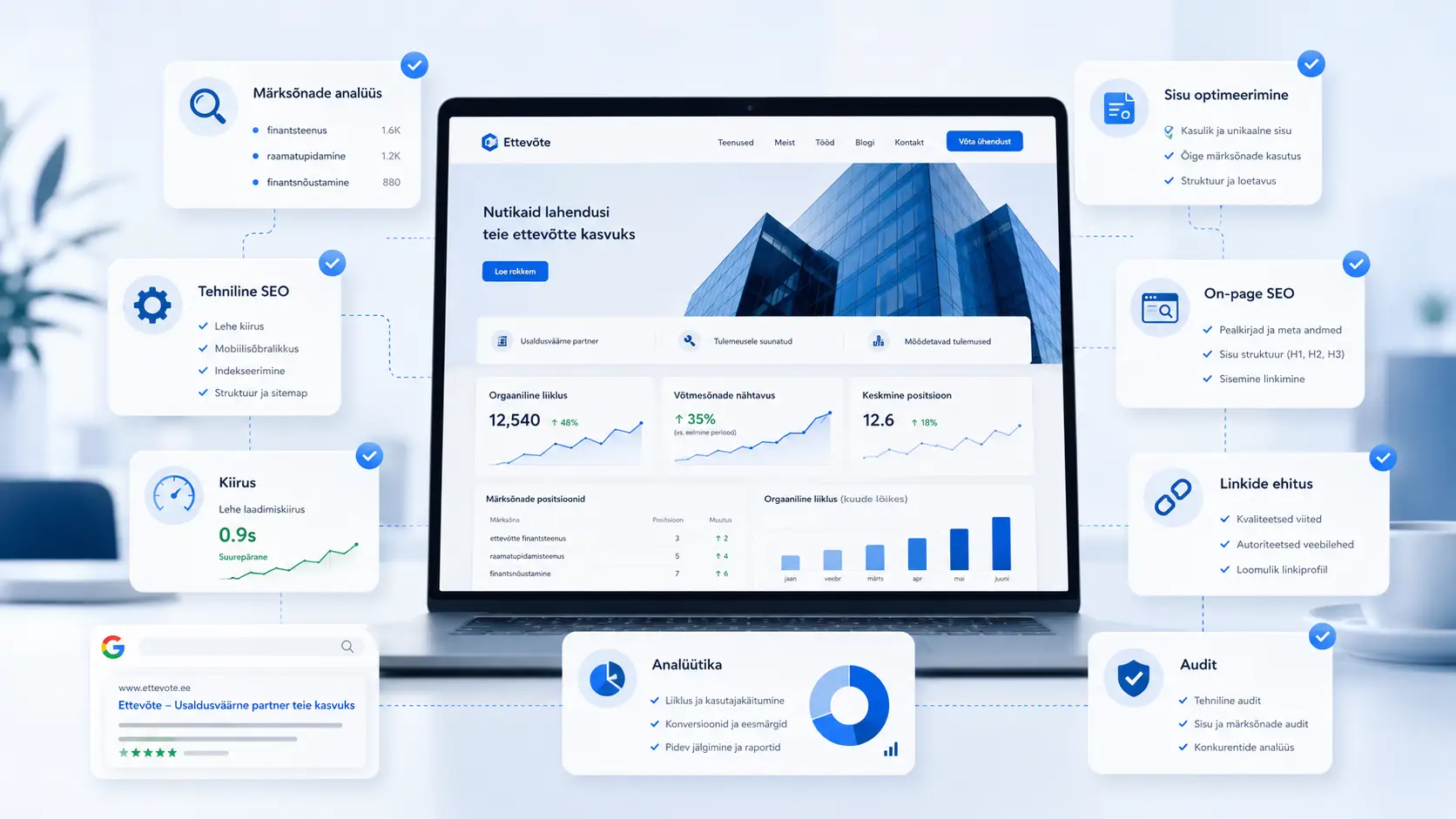
SEO service is one of the most important areas of digital marketing for a company that wants to be easier to find on Google and receive more high-quality enquiries. When a potential customer searches for your service, product or solution, they do not always start with advertising or social media. Very often, the buying journey begins with Google. That is where a person decides which companies they will even start comparing.
Search engine optimization, or SEO, helps make a website more understandable for Google and more useful for the user. Good SEO does not only mean adding keywords into texts. It includes website structure, technical health, content quality, metadata, internal links, user experience, speed, authority and consistent measurement of results.
If a company searches Google for phrases such as “SEO service”, “SEO services”, “SEO agency”, “search engine optimization”, “website SEO” or “website optimization for Google”, it usually has one practical goal: it wants to understand how to get more visibility and enquiries without having to constantly pay for every click.
What will you find in this article?
Here you can quickly move to the most important parts of the article and see what an SEO service actually includes.
What is SEO, or search engine optimization?
In this article, we will look at what an SEO service actually includes, where to start, how to understand whether your company’s website needs SEO, and what kind of result you can expect from search engine optimization.
SEO, or search engine optimization, means optimizing a website in a way that helps search engines better understand its content, structure and value. The most natural English term for this is search engine optimization. Sometimes people also search for the phrase website optimization for search engines, but essentially, the topic is the same: improving a website’s visibility in Google and other search engines.
The goal of SEO is not simply “to be on Google”. The goal is to be visible for the right searches. If a company offers, for example, website development, Google Ads management, construction services, manufacturing services or accounting, it is not important to bring random traffic to the website. What matters is reaching people who are looking for a specific service and may become customers.
Good SEO helps answer three important questions:
- does Google understand what your website is about;
- does the website content match the user’s search intent;
- is the page trustworthy and useful enough to be shown in search results.
If these three parts are in order, the website has a much better chance of receiving organic traffic and enquiries.
Why does a company need an SEO service?
Many companies get some of their customers through referrals, social media or paid advertising. These channels can work very well, but SEO provides something that advertising alone does not: long-term visibility. While Google Ads stops as soon as the budget runs out, well-built SEO can bring traffic for months and years after content has been published.
An SEO service is especially important for a company whose customers look for information before making a purchase decision. This applies to both B2B and B2C fields. If a person wants to know how much website development costs, how to choose a construction company, why Google Ads does not generate enquiries or which SEO service is suitable for a company, they already have interest. If your website answers that question better than a competitor’s website, the chance increases that they will eventually come to you.
SEO helps a company:
- increase organic traffic from Google;
- become visible for important keywords;
- strengthen trust before a sales contact;
- reduce dependence only on paid advertising;
- support the performance of Google Ads and other channels;
- generate better-informed enquiries;
- build a long-term digital marketing system.
SEO is not only a marketing channel. It is part of a company’s digital infrastructure. When the website structure, content and technical foundation are strong, it supports all other marketing activities.
What does an SEO service include?
The content of an SEO service can vary depending on the provider. One SEO agency may focus mainly on a technical audit, another on content creation, a third on links and a fourth on a complete strategy. For a company, it is important to understand what an SEO service should actually include in order to produce business results.
A complete SEO service should include at least the following parts:
- SEO audit;
- keyword research;
- competitor analysis;
- improving the website structure;
- technical SEO;
- optimizing meta titles and meta descriptions;
- improving service pages and category pages;
- creating SEO content and articles;
- an internal linking system;
- image optimization;
- Google Search Console monitoring;
- result reports and recommendations.
The most important thing is that SEO does not remain only at the report level. An audit is not very useful if nothing is changed afterwards. A keyword table will not bring results if better pages are not created based on it. Articles do not work if they are not connected to services, internal links and the user’s need.
A good SEO service combines analysis, technical work, content and measurement.
SEO audit: where should search engine optimization start?
An SEO audit is usually the first step when a company wants to understand why a website is not getting enough visibility or how to improve it. An audit helps show what is already working well and what is preventing better results.
An SEO audit should not be limited only to a list of technical errors. Of course, it is important to check whether the website is indexable, whether pages load quickly, whether metadata exists, whether images are optimized and whether the sitemap works. But it is just as important to assess content, structure and search intent.
For example, a website may be technically healthy, but if all services are placed on one general page, Google may not understand which specific searches it should show that page for. A website may also have a lot of text, but if the text does not answer the customer’s questions, it may not generate enquiries.
A good SEO audit should answer these questions:
- are important pages indexed in Google;
- which keywords the website already appears for;
- which pages receive clicks and impressions;
- which pages need a better meta title and meta description;
- whether the website structure supports services and keywords;
- whether technical errors are blocking visibility;
- whether the content matches the user’s search intent;
- which new pages or articles should be created.
An SEO audit also provides priorities. Not everything has to be fixed at once. It is important to start with the changes that can influence visibility and enquiries the fastest.
Not sure why your website does not bring enough enquiries from Google?
We will review your website structure, visibility, metadata, content and technical foundation. We help you understand whether the problem is in SEO, website structure, content or measurement.
Keyword research: how to find the right searches?
Keyword research is one of the most important parts of SEO. If a company does not know what potential customers search for on Google, it is difficult to create content that reaches those people. At the same time, keyword research does not simply mean choosing phrases with the highest search volume.
It is important to understand search intent. One person is looking for information, another is comparing options, a third wants to know the price and a fourth is ready to order the service. For example, the phrase “what is SEO” is informational. The phrase “SEO service for business” is much more commercial. The phrase “SEO agency in Estonia” may indicate a person who is already looking for a service provider.
A good SEO strategy uses different types of keywords:
- main service keywords, for example “SEO service”;
- synonyms, for example “search engine optimization”;
- long-tail queries, for example “how to improve website visibility in Google”;
- price-related queries, for example “SEO service price”;
- problem-based searches, for example “why my website does not appear on Google”;
- industry-based searches, for example “SEO for construction company” or “SEO for manufacturing company”.
Long-tail keywords can be especially valuable. They may have a smaller search volume, but the searcher’s need is often more precise. If a person searches for “SEO service for small business” or “website optimization for Google”, their problem is much clearer than with the general search “SEO”.
Technical SEO: if Google cannot read the page, it cannot show it well either
Technical SEO means improving the technical health of a website. This is a part that the user may not always notice, but it is very important for Google and for user experience.
If a website is slow, has a confusing structure, broken links, duplicate content or indexing problems, it may block SEO results. A problem can also arise if pages accidentally have a noindex tag, robots.txt blocks important URLs or Google cannot find new pages through the sitemap.
Technical SEO usually includes:
- checking indexation;
- reviewing the XML sitemap;
- checking robots.txt;
- fixing broken links;
- checking redirects;
- improving page loading speed;
- checking mobile friendliness;
- monitoring Core Web Vitals metrics;
- checking secure HTTPS connection;
- checking duplicate content and canonical URLs.
Technical SEO is especially important when the website is larger, multilingual, an e-commerce type website or many years old. Technical problems on a smaller website may be simpler, but they should not be ignored.
Website structure and SEO: why should every service have its own page?
One of the most common SEO problems on company websites is an overly general structure. All services are placed on one page, where there are only a few sentences about each service. The user may get a general overview, but it is difficult for Google to understand which service the page should be visible for.
If a company offers several services, it is better to create separate pages for the most important services. For example, for a digital marketing company, SEO, Google Ads, Meta Ads, e-mail marketing, website development and analytics could each have separate pages. Each page can then answer a specific search intent and be optimized for a specific keyword cluster.
The same applies in other fields. A construction company may have separate pages for renovation, interior finishing, facade works, bathroom renovation and roof construction. A manufacturing company may have separate product and category pages.
A good SEO structure helps:
- Google better understand the website topics;
- the user find the needed service faster;
- create clearer landing pages for advertising;
- strengthen internal linking;
- increase visibility for more searches;
- make the website more useful for the business.
If the structure is weak, SEO work can become slow and imprecise. If the structure is strong, every new article, service page or internal link can support the growth of the entire website.
Meta title and meta description: a small part of SEO with a big impact on clicks
Meta title and meta description are texts that Google may display in search results. They are not the entire foundation of SEO, but they play an important role in whether a person clicks your result or a competitor’s result.
A good meta title should include the main topic or keyword and be clear for the user. For example, “SEO service for companies in Estonia | Visibilion” is much more precise than simply “Services”. A good meta description should explain what the user will get from the page and why it is useful to them.
If metadata is missing, too general or the same on every page, the website may lose clicks even when the Google position is already fairly good. A low CTR may be a sign that the search result is not attractive enough or does not match the user’s expectation.
When optimizing metadata, it is worth making sure that:
- each important page has a unique title and description;
- the main keyword is naturally included in the title;
- the description promises a specific value;
- the text is not over-optimized;
- the headline is not too long;
- the user immediately understands why they should click the page.
Within an SEO service, metadata is one of the most practical and often fastest parts to improve.
SEO texts and content creation: why is a blog not just a blog?
Many companies think of a blog as a place where they occasionally add news. From an SEO perspective, a blog or knowledge base is much more important. It helps answer questions that potential customers search for on Google and bring people to the website before they are ready to order a service.
An SEO text does not mean artificial text filled with keywords. A good SEO article must be genuinely useful. It must answer the user’s question more thoroughly, clearly and reliably than competitors. At the same time, it must be connected to the company’s services, not be random content.
For example, an SEO service provider can write articles on topics such as:
- what an SEO service for a company includes;
- how much an SEO service costs;
- how to use Google Search Console;
- why a website does not get traffic from Google;
- how to write meta title and meta description;
- how to choose an SEO agency;
- how SEO and Google Ads work together.
Such articles cover different search intents. One person is only learning what SEO is. Another is looking for a service provider. Another wants to know the price. Another wants to understand why their existing website does not work. If the website covers the entire journey, its authority and visibility grow.
Internal linking: how does one article support another page?
Internal linking means links between different pages of the same website. It may seem like a small detail, but for SEO it is very important. With internal links, you can show Google which pages are important and how topics are connected to each other.
For example, an article “SEO service for business” could link to the SEO service page, a Google Search Console article, a metadata article, a website development article and a case study. This way, the user can move on to the next useful topic and Google better understands the website’s topical structure.
Good internal linking:
- helps the user find related information;
- strengthens the most important service pages;
- improves page indexing;
- distributes SEO value inside the website;
- helps create topic clusters;
- reduces random exits from the page.
With internal links, it is important to use natural anchors. “Read here” is possible, but it is much better to use descriptive anchors such as “SEO service”, “Google Search Console data” or “website optimization for Google”.
Google Search Console: how to measure SEO results?
SEO should not be done only based on feelings. Google Search Console is one of the most important tools that shows how a website actually performs in Google Search. There you can see which queries the website appears for, how many impressions and clicks it receives, what the CTR is and which pages are stronger in organic search.
For a company, it is especially valuable to look not only at clicks, but also at impressions. If a page receives many impressions but few clicks, the problem may be in the meta title, meta description or position. If a page appears for many interesting queries, this can provide ideas for creating new articles or service pages.
Search Console helps answer questions such as:
- which keywords already bring visibility;
- which pages receive clicks;
- where CTR is low;
- which queries require better content;
- whether new articles are starting to appear in Google;
- whether important pages are indexed;
- whether SEO work is moving in the right direction.
A good SEO service should include regular monitoring of Search Console data and making decisions based on that data.
How quickly does SEO produce results?
SEO results usually do not appear overnight. Sometimes the first improvement can be visible within a few weeks, especially if technical errors, metadata or existing strong pages are being fixed. But more significant growth usually takes time.
If a website is new, has little content and a weak structure, SEO can take several months. If a website already has visibility but needs improvement, the first results may come faster. If competition is high, for example in marketing, construction, finance or e-commerce, SEO requires more consistent and long-term work.
In general, the first SEO results can be expected in about 2–3 months if the work is done regularly. Larger and more meaningful results may require about 5–7 months or more. This does not mean that nothing happens during that time. SEO often grows gradually: first impressions improve, then positions, then clicks and only then enquiries.
The speed of SEO results is influenced by:
- the current state of the website;
- the level of competition;
- the quality of existing content;
- technical problems;
- the frequency of publishing new content;
- domain strength and external links;
- how well the website responds to search intent.
It is important to understand that SEO is not a one-time button. It is a process where results accumulate over time.
SEO agency, freelancer or in-house specialist?
A company can handle SEO in different ways: hire an SEO specialist, work with a freelancer, turn to an SEO agency or choose a digital partner that connects SEO with the website, advertising, analytics and content.
An in-house specialist can be a good choice if the company has a large website, a lot of content, constant tasks and a sufficient budget. But one person does not always cover everything: technical SEO, content, copywriting, web development, analytics and strategy.
A freelancer can be a more flexible and accessible solution, but quality depends heavily on the specific person. An SEO agency can offer a broader team, but sometimes the work becomes too template-based or too focused on reporting.
For many small and medium-sized companies, the best option is a partner who does not look at SEO separately, but together with the website, advertising and sales. Because SEO rarely works in a vacuum. If the website is weak, forms are inconvenient, texts are unclear or analytics is not set up, SEO actions alone may not be enough.
When choosing the format, it is important to understand:
- whether only an audit or regular work is needed;
- whether the company can implement recommendations;
- who will write and publish content;
- who will handle technical fixes;
- how results are measured;
- which tasks are one-time and which are regular;
- what input the provider needs from the client;
- when results can realistically be expected.
If a provider promises “first place in Google quickly and guaranteed”, it is worth being cautious. In SEO, a lot can be done, but it is not possible to honestly guarantee Google results.
How to choose an SEO provider?
When choosing an SEO provider, you should not look only at the price. It is more important to understand whether the provider understands your company’s goal and knows how to connect SEO work with business results.
A good SEO provider does not immediately start by stuffing keywords. They try to understand which customers the company wants, which services are priorities, what website already exists, which channels already work and where the biggest growth potential is.
When choosing an SEO partner, it is worth asking:
- whether the work starts with an SEO audit;
- how keywords are selected;
- whether search intent is assessed;
- whether the technical side is improved;
- whether content is created or optimized;
- how internal linking is handled;
- whether Google Search Console data is used;
- what the reporting logic is;
- whether the recommendations are understandable in practice;
- whether SEO is connected to enquiries and sales.
SEO should not be a black box where the client receives a report once a month but does not understand what was actually done. Good cooperation is transparent and practical.
How much does an SEO service cost?
The cost of an SEO service depends on the scope of work. A one-time SEO audit may cost less than monthly SEO support. In the case of a smaller company, it is possible to start with a technical and content-focused basic audit, fixing metadata and optimizing a few important service pages. In the case of a larger company, SEO may include a regular content plan, dozens of pages, technical fixes, several languages and continuous analysis.
When thinking about SEO pricing, it is worth thinking not only about the cost, but also about the value. If SEO steadily brings enquiries over time, it can be much more useful than short-term advertising that ends together with the budget. At the same time, this does not mean that SEO replaces advertising. Often SEO and Google Ads work best together: advertising provides faster data and contacts, while SEO builds long-term visibility.
The cost of an SEO service usually depends on:
- the size of the website;
- the number of technical problems;
- competition;
- the number of keywords;
- the need for content;
- the number of languages;
- the scope of reporting and analysis;
- whether web development is also needed.
If an offer is very cheap, it is worth checking what it actually includes. If it only includes a few metadata changes or one general report, that may not be enough. If an offer is expensive, it should be clear what strategy and scope of work the price includes.
SEO and Google Ads: which is better?
SEO and Google Ads are not opposites. They are different channels that can strengthen each other. Google Ads helps quickly reach people who are looking for a specific service. SEO helps build long-term visibility and reduce dependence on paid traffic.
If a company needs enquiries immediately, Google Ads can be faster. If a company wants its website to be found for more searches over time, SEO is needed. Ideally, these channels should work together.
For example, Google Ads can show which keywords bring clicks and enquiries. This data can be used for the SEO strategy. SEO articles and service pages, in turn, can improve the quality of landing pages for advertising. If a page is strong, it performs better in both organic search and paid advertising.
SEO is better suited when:
- the company wants to build long-term visibility;
- there is demand in Google;
- the website can be developed regularly;
- it is important to reduce dependence on paid advertising;
- the company wants to answer customer questions through content.
Google Ads is better suited when:
- quick clicks and enquiries are needed;
- an offer needs to be tested;
- SEO has not had time to grow yet;
- the campaign is limited in time;
- visibility needs to be controlled for specific searches.
The strongest result often appears when SEO, Google Ads, content and the website are treated as one system.
When does a company website need SEO?
A website needs SEO if the company wants to be found on Google. This sounds simple, but in practice it means several situations.
SEO is needed if:
- the website does not get traffic from Google;
- enquiries come only from advertising or referrals;
- competitors appear higher in search;
- service pages are too general;
- new pages do not get into Google;
- meta title and description are incomplete;
- the blog or articles do not bring traffic;
- the website is technically slow or confusing;
- the company wants to increase long-term visibility.
SEO is especially important when creating a new website. If SEO is considered only after the website is finished, part of the structure may need to be rebuilt. It is much better to plan SEO from the beginning: which service pages to create, which keywords matter, what URL structure to choose and how to build the content.
Summary: an SEO service helps make a website visible, understandable and useful
An SEO service is not just a technical add-on and it is not simply adding keywords into texts. Search engine optimization is complex work that helps make a website more understandable for Google and more valuable for the user.
Good SEO starts with an audit and keyword research. Then the structure, technical side, metadata, content and internal links need to be improved. Results need to be monitored with Google Search Console and other tools. Over time, regular SEO work helps increase visibility, traffic and the number of enquiries.
For a company, the most important thing is to think of SEO as a long-term growth channel. If the website answers customer questions better, is technically healthy and has a clear structure, it has a much better chance of reaching the right people on Google.
If your company wants to be easier to find on Google, receive more high-quality traffic and turn the website into a stronger sales channel, SEO should be done systematically, not randomly.
We will make your website more understandable for Google and more useful for the customer.
If you want more visibility, better-quality traffic and a website that works better, we can start with a clear SEO overview. We will look at what should be improved in structure, content, technical setup and measurement.
Send us your website address and a short goal. We will tell you where it would be most reasonable to start with your SEO.
Contact us →